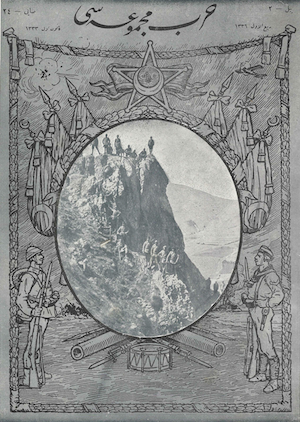
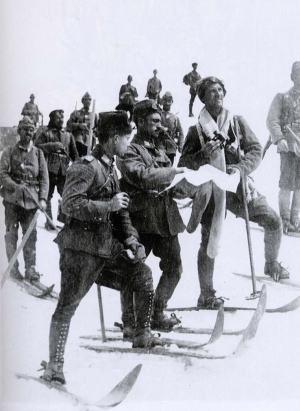
30 October 1914 coincided with the first day of a major Islamic religious feast. In Erzurum, where the headquarters of the Third Army was located, an atmosphere of joy resonated among the Turkish troops stationed in the city. These celebrations, however, were abruptly interrupted by the arrival of a telegram from the High Command in Istanbul. The message reported an exchange of fire between Russian and Ottoman vessels in the Black Sea and warned that the Imperial Russian Army was mobilizing along the Ottoman border.
 Under the command of Hasan İzzet Pasha, the Ottoman Third Army consisted of the IX, X, and XI Corps. Erzurum served as the location of the army headquarters as well as the base of the IX Corps, while the X Corps was stationed in Sivas and the XI Corps in Mamuretülaziz. The operational zone of the Third Army extended over a vast area of approximately 1,250–1,500 kilometres and was characterized by severely underdeveloped transportation infrastructure. With a total strength of roughly 190,000 personnel, the army comprised 83,000 regular troops in addition to reserves, Erzurum Fortress garrison units, transportation formations, depot regiments, military police units, and logistical support elements, including approximately 60,000 animals.
The Russian offensive began on 1 November 1914, one day prior to the formal declaration of war. The Russian I Corps advanced from Sarıkamış toward Köprüköy, while the Russian IV Corps moved from Yerevan toward the Pasinler Plain. By 4 November, Russian forces had reached Köprüköy and were simultaneously advancing along the Karaköse–Muratsuyu axis. The Russian force deployed for this operation consisted of 25 infantry battalions, 37 cavalry units, and 120 artillery pieces. These developments marked the opening of a decisive phase in the campaign.
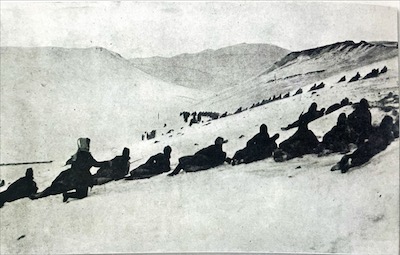
On the day of the Russian offensive, orders from Enver Pasha reached the Third Army headquarters: “The enemy does not appear superior. The X Corps requires an additional 2-3 weeks to reach the frontline. To buy time and boost army morale, I contemplate launching separate attacks on the enemy. You will strike to the rear of the Russians, Kurdish Tribal Regiments will infiltrate beyond enemy lines, and the forces in Van will assail Persian Azerbaijan.” Hasan İzzet Pasha opposed an offensive in harsh winter conditions, intending to remain on the defensive, lure the Russians to the Erzurum Fortress, and counterattack at an opportune moment. However, immediate attack orders left him no choice.
The main Russian attack was directed along the Erzurum–Sarıkamış road and was supported by a strong auxiliary advance from Oltu. On 7 November, the Third Army launched its counteroffensive employing the XI Corps together with all available cavalry units. The operation, however, suffered from a lack of coordination, as the cavalry failed to carry out the intended encirclement manoeuvre, and the Kurdish Tribal Regiment performed below expectations. Following the withdrawal of the 18th and 30th Divisions, Russian forces succeeded in gaining ground. In consultation with his German chief of staff, Colonel Felix Guse, Hasan İzzet Pasha considered withdrawing to Erzurum in order to limit further losses. This proposal was opposed by the commander of the XI Corps, Galip Pasha, who ultimately persuaded Hasan İzzet Pasha to abandon the idea of retreat. As a result, Ottoman forces maintained their positions at Köprüköy, bringing the First Battle of Köprüköy to a close without a decisive outcome.
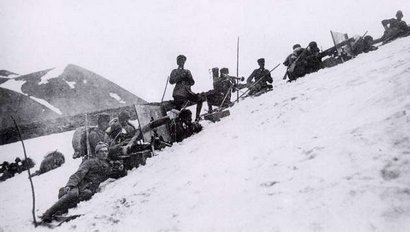
On 12 November 1914, the IX Corps, under the command of Ahmet Fevzi Pasha, reinforced the left flank of the XI Corps, marking a significant turning point in the engagement. With cavalry support and despite severe weather conditions, including a heavy snowstorm, Ottoman forces initiated a sustained advance against the retreating Russian troops in what became known as the Second Battle of Köprüköy.
Advancing across rugged, rocky terrain and crossing frozen river, often wading through icy waters, the troops succeeded in occupying Köprüköy. This tactical success, however, produced only limited strategic benefits within the wider framework of the campaign. Although compelled to withdraw, Russian forces continued to demonstrate resilience, particularly through the resistance of the 3rd Infantry Regiment.
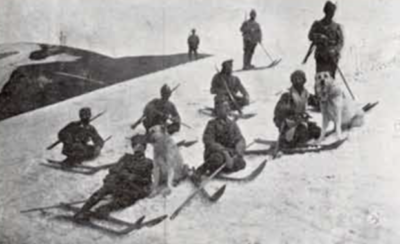
These developments culminated in the Azap Offensive, which took place between 17 and 20 November 1914. Growing concern permeated the Russian command structure as field commanders, in correspondence with the Caucasian Army High Command in Tbilisi, conveyed increasingly pessimistic assessments of the situation and warned of a potential defeat. At the same time, the Third Army faced mounting difficulties as weather conditions worsened and casualties increased significantly, with approximately 9,000 soldiers killed, 3,000 captured, and 2,800 reported as deserters.
Eyewitness accounts indicate that Hasan İzzet Pasha was under severe psychological strain, reportedly approaching the point of a nervous breakdown. Despite limited territorial gains, Ottoman forces were confronted with the inescapable realities imposed by an exceptionally harsh climate. Under orders from the High Command in Istanbul to continue offensive operations, Hasan İzzet Pasha faced considerable difficulty in devising and executing an effective military manoeuvre under such adverse environmental and operational conditions.
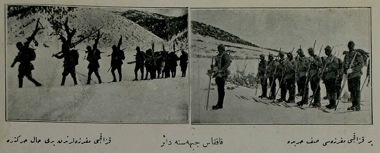
By the end of November, a tenuous equilibrium had emerged along the front. Russian forces had established themselves in a salient extending approximately 25 kilometres into Ottoman territory along the Erzurum–Sarıkamış axis. The battles that had unfolded across this theatre of war produced a fragile balance, shaped jointly by severe climatic constraints and competing strategic considerations.
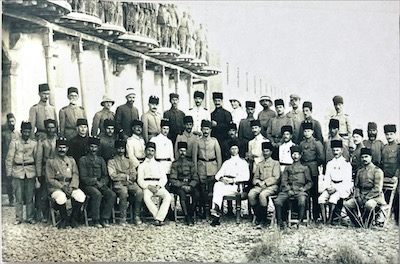
On 8 December 1914, Colonel Hafız Hakkı Bey, Assistant Chief of Staff of the Ottoman Army, arrived in Trabzon aboard the cruiser Mecidiye. Dispatched by Enver Pasha, his mission was to reinvigorate the Third Army and reassess its operational posture. In contrast to Hasan İzzet Pasha’s preference for maintaining a defensive stance throughout the winter and launching an offensive in the spring, Hafız Hakkı Bey promptly initiated preparations for a renewed offensive campaign.
Despite serious reservations expressed by Hasan İzzet Pasha and the corps commanders regarding the feasibility of such an operation, a telegram dated 18 December 1914 conveyed his concerns to Enver Pasha in unequivocal terms: “We must allocate eight or nine days for a large-scale encircling manoeuvre. However, during this time, the XI Corps, stationed at the front, might be compromised. Even with two corps executing the manoeuvre, they will likely encounter difficulties against the enemy.”
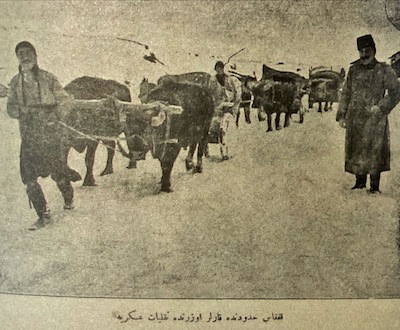
Firmly convinced that the Russian forces could be encircled and destroyed at Sarıkamış, Enver Pasha was unsettled by the contents of Hasan İzzet Pasha’s telegram. When the two generals holding fundamentally divergent views on the conduct of the campaign met at Köprüköy, Enver Pasha was unable to conceal his dissatisfaction. This meeting, vividly described by Kazım Bey, who was not only Assistant Chief of Staff but also Enver Pasha’s brother-in-law, records Enver’s pointed reproach to Hasan İzzet Pasha: “Mistakes have been made, and you have faltered. The Russian Army was meant to face annihilation here. Now, you must take immediate action to obliterate the Russians at Sarıkamış.”
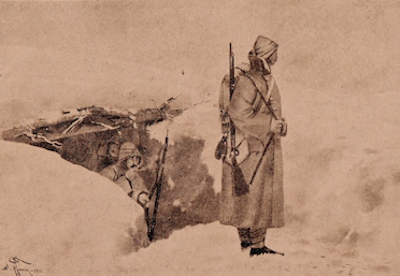
Hasan İzzet Pasha, having exhausted his patience, retorted, “This is impossible! Survey the surroundings yourself. It is winter, amid snowstorms. In such conditions, at this time of year, a military operation is destined for failure. I will annihilate the enemy once winter yields and roads become passable.” Enver Pasha, infuriated by this reply, reportedly exclaimed, “I would have you executed if you were not my teacher”, a remark underscored by the fact that Hasan İzzet Pasha had previously served as Enver Pasha’s instructor at the Staff College. As a consequence of his refusal to launch an immediate offensive, Hasan İzzet Pasha was forced into retirement, after which Enver Pasha appointed himself commander of the Third Army.
Enver Pasha sought to replicate the German victory at Tannenberg by employing a comparable strategy based on a wide-ranging encirclement manoeuvre. However, a critical miscalculation underpinned this ambition, as the conditions at Sarıkamış differed fundamentally from those at Tannenberg. The mountainous and hazardous terrain of the Caucasus, compounded by the severe conditions of winter, bore little resemblance to the relatively temperate and accessible environment of the European summer in which the Battle of Tannenberg had been fought. Moreover, the Ottoman Army, lacking the level of equipment, logistics, and overall preparedness available to German forces, was placed at a significant disadvantage. Despite these constraints, the German High Command supported Enver Pasha’s plan, viewing it primarily as a means of diverting Russian forces away from the Polish front and thereby easing pressure on German operations elsewhere.
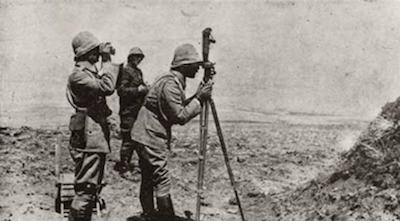
The memoirs of General Liman von Sanders offer revealing insights into this period. He recalled: “Before the Caucasian campaign began, Enver explained his plans to me in detail. At the conclusion of our meeting, he disclosed his ambitious, if somewhat peculiar, aspirations. Following the completion of operations in the Caucasus, he intended to advance toward India and Afghanistan.”
At the same time, a specialized detachment was formed from the 3rd Division stationed in Thrace. Deployed to the Çoruh region, its mission was to contain Russian forces along the Batumi coast. This manoeuvre enabled the X Corps to shift from a primarily defensive coastal role to a more concentrated offensive posture. Commanded by the German Major Stange, the unit became known as the “Stange Bey Detachment.”
Dissatisfied with the existing leadership of the Third Army, Enver Pasha implemented additional command changes. Colonel İhsan Bey replaced Ahmet Fevzi Pasha as commander of the IX Corps, while Colonel Hafız Hakkı Bey succeeded Ziya Pasha as commander of the X Corps. Notably, both newly appointed commanders lacked prior experience in large-scale operational command.
Sarıkamış Disaster
The Ottoman operational plan envisaged a single, large-scale envelopment executed by three corps. On the right flank, the XI Corps was tasked with engaging Russian forces and conducting diversionary attacks to fix them in place. In the centre, the IX Corps was to advance toward the Sarıkamış Pass. On the left flank, Hafız Hakkı Bey’s X Corps was assigned a decisive role: advancing to Oltu, crossing the Allahüekber Mountains, severing the Kars road, and driving Russian forces into the Aras Valley, where all three corps were to converge and destroy them. Concurrently, the Stange Bey Detachment was to undertake conspicuous operations designed to distract and immobilise Russian units.

Highly confident in the plan, Hafız Hakkı Bey awaited the offensive with evident enthusiasm. In a letter dated 19 December 1914 and addressed to İhsan Pasha, he outlined exceedingly ambitious objectives that rested on tenuous assumptions: “The IX and X Corps must reach Sarıkamış and Kars before the Russians. To achieve this, two conditions are essential. A sudden initial blow and rapid exploitation thereafter. I intend to crush the enemy within one or two hours and then advance toward Oltu… The attack at İd must be concluded by the afternoon of 22 December. Thereafter, we shall advance at a rate of 30 kilometres per day and reach the Kars–Sarıkamış line by 25 December.”
At the outset of the major offensive, the Third Army deployed an effective strength of approximately 118,660 men, supported by 73 machine guns and 218 artillery pieces. Ottoman intelligence estimated Russian rifle strength at around 65,000.
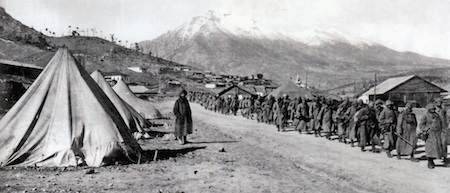
Hostilities commenced on 22 December 1914, marking the opening of a critical phase of the campaign. The X Corps began its advance toward Oltu and occupied the town on the following day. During this operation, approximately 1,000 Russian soldiers were taken prisoner, and four artillery pieces and four machine guns were captured. At the same time, the IX and XI Corps advanced on their respective axes in accordance with the operational plan.
The second day of the campaign, however, was marked by a serious and unfortunate incident. At Narman, the 31st and 32nd Divisions inadvertently engaged one another in combat for nearly four hours. This grave error has been attributed primarily to deficiencies in cartographic materials and navigational difficulties. By 24 December, the X Corps had advanced beyond Oltu, having covered an arduous distance of approximately 75 kilometres in just over three days. At this stage, the corps prepared to pivot southeastward in order to execute a flanking manoeuvre aimed at encircling Sarıkamış.
On 25 December 1914, Enver Pasha issued a notable order of the day in which he reported recent successes and outlined subsequent operational objectives. The capture at Oltu of approximately one thousand enemy soldiers, including officers and a colonel, together with six artillery pieces, four machine guns, rifles, and additional equipment, was presented as a decisive victory. At the same time, the IX and X Corps were exerting pressure across their respective sectors, forcing some Russian units toward Ardahan while driving others into the mountainous terrain.
Enver Pasha’s directives to the army were explicit and uncompromising. The lines of communication linking the enemy to Kars were to be severed, and on 25 December the 29th and 17th Divisions of the IX Corps were expected to reach Sarıkamış. The frontline was to be shifted southeastward, with particular emphasis placed on seizing key passes and occupying the town itself. The 28th Division was ordered to secure Bardız and to establish defensive positions against potential attacks from the direction of Yeniköy.

As the X Corps advanced toward Sarıkamış, detailed planning continued, and army headquarters awaited reports on its progress. In the interim, the XI Corps and the 2nd Cavalry Division operated without precise directives, adjusting their actions in accordance with the broader operational intent. Should Russian forces retreat, they were to be destroyed at Sarıkamış; if they chose to stand fast, the IX and X Corps were prepared to strike them from the rear.
The army headquarters, which remained in Bardız until midday on 25 December 1914, planned to relocate to Sarıkamış, where it was expected to remain on the following day, 26 December. These movements and the decisions accompanying them constituted a critical episode in the campaign, one that would profoundly shape the subsequent course of operations in this strategically significant theatre of war.
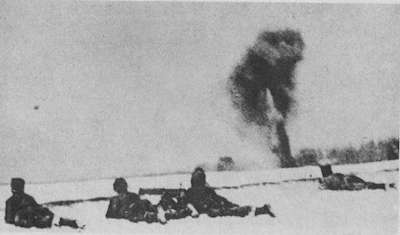
At 7:00 a.m. on 26 December 1914, the 29th Division departed from Bardız. Although no snowfall was occurring at the time, the Bardız Plain was already covered by deep snow reaching up to the soldiers’ knees, rendering movement extremely difficult. The animals hauling the howitzers became mired in the snow, further impeding the advance. In light of these conditions, Colonel Arif Bey, the divisional commander, proposed halting at the village of Kızılkilise to allow the troops to rest. Enver Pasha, however, rejected this suggestion and ordered the march to continue.
The troops were gravely ill-prepared for the severity of the winter conditions. Many lacked proper footwear and were equipped only with simple sandals, which, once soaked, froze and became heavy, rigid burdens around their feet. Despite these circumstances, the soldiers were not permitted to halt and warm themselves by campfires. As they struggled to stave off frostbite, many found it impossible to do so. The effects of cold injury first appeared in their toes and wrists; after only a few more steps in the snow, their limbs became immobilised, with frostbite rapidly spreading throughout their bodies. This grim fate befell countless young Ottoman soldiers on the plains of Eastern Anatolia.
By the afternoon, Russian defensive positions came into view. Colonel Arif Bey approached the corps commander, Colonel İhsan Bey, and proposed that the troops be allowed to rest overnight in order to recover and launch an assault at dawn the following day. While İhsan Bey agreed with this assessment, Enver Pasha insisted on proceeding with a night attack, disregarding the fact that battalion strengths had been reduced to fewer than 200 men and that temperatures had fallen to 26 degrees below zero. In the darkness, the Allahüekber Mountains appeared as a vast white inferno of snow, enveloped in an oppressive stillness that conveyed the presence of death.
On that night, the 86th and 87th Regiments succeeded in repelling Russian forces and securing the strategically important height of Çamurludağ. Initially, Turkish officers believed that Sarıkamış lay immediately beyond the hill; however, it soon became apparent that the town was in fact approximately eight kilometres away. This miscalculation was largely the result of inadequate and unreliable cartographic information. Reinforcements nonetheless arrived in a timely manner, as the 17th Division reached Çamurludağ following an exhausting twenty-two-hour march.
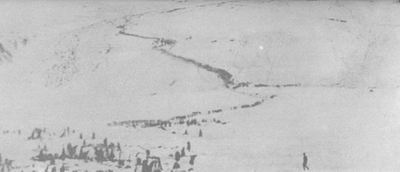
At the same time, units of the X Corps under the command of Colonel Hafız Hakkı Bey continued their advance after marching for fourteen continuous hours. Exhaustion and hunger gradually supplanted the earlier fears of frostbite and Russian machine-gun fire, giving way to a profound sense of physical indifference. In the early hours of 26 December 1914, during the eighteenth hour of this relentless march, the 91st Regiment of the X Corps came under enemy fire. After nearly two hours of intense fighting, Russian forces withdrew, enabling the regiment to resume its advance just as a snowstorm descended upon the area. Despite these conditions, the 91st Regiment reached Kosor twenty-one hours after departing from Penek, having covered a distance of only eight kilometres. Comparable rates of progress characterized other units, some of which halted to rest in the villages of Kosor, Arsenik, and Patsik, located approximately 40, 35, and 30 kilometres from Sarıkamış, respectively. Beyond these positions rose the formidable Allahüekber Mountains, whose crossing would require at least two additional days before Sarıkamış could be reached.
On the morning of 26 December 1914, Enver Pasha, General Bronsart von Schellendorf, and other senior officers observed Sarıkamış through their binoculars. Nestled within the mist-covered forests of Çamurludağ, the village of Çerkezköy signalled the town’s immediate vicinity. Sarıkamış itself, with its railway station, Russian barracks, and prominent church buildings, appeared animated despite the harsh winter conditions. Enver Pasha’s operational design envisaged the seizure of the town by the IX Corps, followed by the encirclement of Russian forces and the prevention of their withdrawal toward Kars, thereby ensuring their complete destruction.

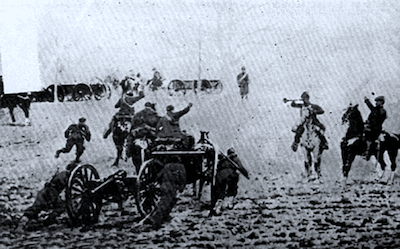
The attack commenced at 7:30 a.m. Russian forces had positioned themselves strategically in the northern forests of Çerkezköy, where they awaited the advance of the Ottoman troops. As Turkish units moved forward, they were met with sustained and concentrated heavy machine-gun fire. At the same time, Russian artillery subjected Ottoman howitzers to continuous bombardment, effectively neutralising their ability to respond and rendering counter-battery fire largely ineffective.
Combat continued throughout the day, with the battlefield reverberating under the intensity of sustained engagement. As night fell, İhsan Pasha, commander of the IX Corps, approached Enver Pasha with a sobering assessment of the situation: “Our forces designated for the assault are insufficient, and our reserves have been exhausted. The Yeniköy road is exposed, creating the risk that the enemy may seize Çamurludağ and threaten our rear. Without reserves, it is impossible to redeploy units. May we reorganise overnight, restore order, and renew the offensive tomorrow morning?” Confronted with the gravity of the circumstances, Enver Pasha accepted this proposal.
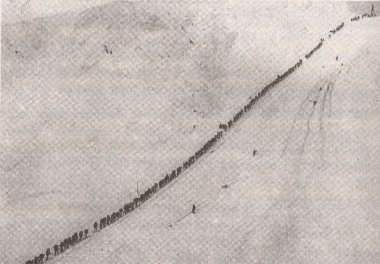
After spending the night of 25–26 December 1914 in three separate villages, the units of the X Corps comprising the 30th, 31st, and 32nd Divisions set out again at 5:00 a.m. The corps began the arduous ascent of the Allahüekber Mountains. No snow was falling at the time, and the sun was visible, yet with increasing altitude the wind intensified and the cold grew more severe. Movement through deep snow became increasingly difficult, and soldiers began to collapse one after another from exhaustion and exposure. From the rear, a grim spectacle was visible: two parallel lines of grey figures on the mountainside, one slowly advancing, the other standing motionless. As the ascent continued, the immobile column steadily lengthened, bearing silent witness to the devastating human cost of the march.
Fatigue, hunger, and sleep deprivation afflicted the troops, conditions further exacerbated by the absence of adequate winter clothing. Under such circumstances, their prospects for survival were minimal. Exhausted soldiers collapsed to their knees, devoid of strength, unable to move or even speak. Overcome by dizziness, many drifted into a deep sleep from which they would never awaken. In this manner, the unforgiving terrain imposed a somber and irrevocable conclusion on a fateful march, signalling the beginning of the end of the operation.
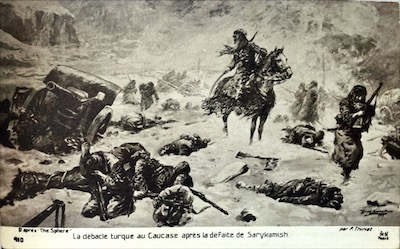
After an ordeal lasting fourteen harrowing hours, the so-called “death march” came to an end, and the remnants of the X Corps succeeded in reaching their initial objective, the village of Beyköy. A subsequent roll call revealed catastrophic losses, with casualties amounting to approximately 90 percent of the force. Only 1,400 men of the 30th Division reached Beyköy, while an estimated 15,000 soldiers perished in the mountains. A similar fate befell the other two divisions: tens of thousands of lives were lost without a single shot being fired in combat.
"We left the village when it was still dark. The privates were following the corporals in complete silence. We had local guides and according to the maps we had, we believed we could reach the summit in three hours. We walked twice that long, and the road was still going up. As we climbed higher, the scenery became wilder, but more beautiful. It looked as if the whole place was made of endless snow and rivers. We could see the hills covered with snow and ice below us. I could not imagine how our artillerists could make it up this steep snowy mountain. We were climbing under difficult circumstances but we kept order and discipline. Finally, we reached the highest point, which was a wide snow plain... We were exhausted. A sharp wind blew over us, and then came a snowstorm. Visibility was nil. Nobody could speak or say anything, let alone help each other. The long marching column dissolved. Soldiers went away wherever they could see a black point at the edge of a forest or a riverbank, any place where they could see smoke from a fire.The officers tried hard, but no one listened to them. I can still remember the scene. A private kneeling in the snow beside the road, screaming, wrapping his arms tightly around a pile of snow, biting it and scratching it with his finger nails. I tried to help him stand up to take him back to the road. He did not respond at all and he kept on doing it. The poor man had gone mad. We left more than ten thousand souls like that, in one single day under the snow in those cursed glaciers." (An officer from the 93rd Regiment of the 31st Division, in his memoirs)
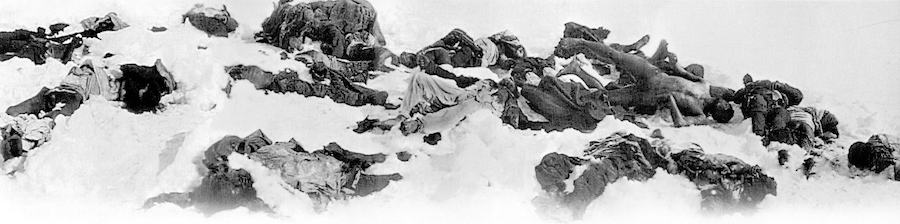
The 93rd Regiment, which had originally numbered approximately 5,000 men, reached the village of Başköy with only 300 survivors. In order to prevent a similar catastrophe from overtaking the remaining units, Colonel Hasan Vasfi Bey, commander of the 31st Division, issued a critical order. He declared that the earlier directive requiring all units to reach Başköy that same night was impracticable. The route between Arsenik and Başköy, involving more than seven hours of marching across a winding plain, was extremely dangerous. The icy conditions had already claimed the lives of both soldiers and animals, whose bodies lay scattered along the route. Having witnessed this devastating scene, Colonel Hasan Vasfi Bey judged that attempting the crossing at night would amount to certain death. Accordingly, a revised plan was adopted. Units that had already departed Arsenik were instructed to spend the night in a large pine forest west of the plain, in the direction of the village of Yayla. They were ordered to light fires to keep warm and to avoid sleeping in order to prevent frostbite, before resuming their march to Başköy the following day. In addition, a rest day was declared for all units on the subsequent day. For those formations that had not yet left Arsenik, the order stipulated that experienced guides were to be secured and that the Issızdere route should be used.
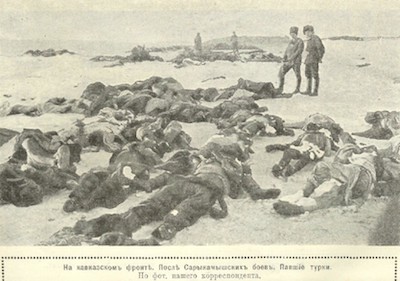
The dawn of the following day revealed the full magnitude of the catastrophe. Of the original strength of approximately 32,300 men in the 30th and 31st Divisions, only 3,400 survivors remained, the majority of whom were physically debilitated. The 32nd Division was immobilised at Bardız, where it confronted a substantial Russian force, while Russian units had effectively cut off the rear of the 30th and 31st Divisions, further compounding their isolation.
In response to directives issued by Enver Pasha, Colonel Hafız Hakkı Bey annulled the previously ordered rest day. Instead, he instructed the remnants of his corps to move toward the Divnik–Çatak line with the objective of destroying Russian units at Novoselim and encircling what was believed to be a retreating enemy from Sarıkamış. These assumptions proved incorrect, as Russian forces were in fact consolidating and strengthening their defensive positions in Sarıkamış. At the same time, Enver Pasha personally ordered the 29th Division of the IX Corps to undertake a renewed assault against the Russian defenses surrounding the town.
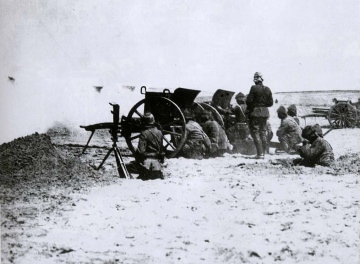
In the final days of December 1914, the 87th Regiment, commanded by Lieutenant Colonel Lütfullah Bey, achieved a brief tactical success by entering Çerkezköy. This success, however, was short-lived, as the regiment soon found itself encircled within the village. Russian forces under Colonel Barkovski had not relinquished control of the area. Fighting continued throughout the daylight hours, and by the following morning the Ottoman troops in Çerkezköy were overwhelmed and taken prisoner.
Confronted with the impracticality of continuing the advance on Sarıkamış with the IX Corps alone, Enver Pasha decided to pause operations. 28 December 1914 was declared a day of rest while awaiting the arrival of Colonel Hafız Hakkı Bey’s X Corps. In the meantime, elements of the X Corps reached the Sarıkamış–Kars railway line and destroyed sections of the track. Simultaneously, the 31st Division arrived in the vicinity of Sarıkamış. Colonel Hafız Hakkı Bey was confronted with a sobering reality: of the division’s original strength of approximately 14,000 men, only about 1,000 exhausted soldiers remained. Faced with this situation, a decision was taken to withdraw in order to regroup and preserve what remained of the force for a potential renewed offensive.
As Ottoman units moved toward the village of Yağbasan, they came under intense Russian machine-gun fire. A brief but fierce engagement followed, after which Russian forces withdrew toward Sarıkamış, setting the conditions for the subsequent phase of this tragic and consequential campaign.
Enver Pasha remained with the IX Corps, where Corps Commander İhsan Pasha’s growing frustration stemmed largely from Enver’s frequent and direct interventions in operational command. Observing what he regarded as Enver Pasha’s unwarranted optimism, İhsan Pasha, whose scope for independent action had become increasingly constrained, could do little more than present the unvarnished realities of the situation. On 28 December 1914, he submitted a comprehensive report detailing the corps’ condition. Enver Pasha responded dismissively, stating: “Today I saw corps and division commanders in the rear. Everyone must be at the front. Our reports constantly emphasize shortages in manpower, yet I personally observe that Russian companies also have no more than twenty men.”
Enver Pasha was operating under the assumption that Russian forces were retreating toward Kars. In reality, what he interpreted as a withdrawal was in fact an encirclement manoeuvre. Initially, this misconception filled him with optimism. This confidence, however, quickly gave way to disillusionment when a Russian prisoner of Turkic origin was brought before him. The prisoner warned: “The Russians are preparing to encircle your forces at Sarıkamış with five regiments.” This revelation forced Enver Pasha to confront the true extent of the situation. The IX Corps, which had reached Sarıkamış, had been effectively depleted. The X Corps, expected to provide decisive support, had lost approximately 90 percent of its strength on the slopes of the Allahüekber Mountains. The XI Corps remained engaged with Russian forces in the Aras region. Meanwhile, a regiment that had entered Çerkezköy had been captured, leaving the remaining Ottoman forces vulnerable to encirclement.
On 29 December 1914, Hafız Hakkı Bey attempted to recapture Sarıkamış using the remnants of the X Corps. The initial assault by the 88th Regiment was repelled, after which the 31st Division launched a more coordinated attack. Colonel Lange, a German officer, advanced from the south, while Colonel Hasan Vasfi Bey attacked from the north, advancing to within 250 meters of the town’s defensive line. Despite stiff Russian resistance, a renewed assault at approximately 4:00 p.m. reflected a surge in Ottoman morale, driven by the realization that this represented their final opportunity. Taken by surprise, Russian troops panicked, abandoned their forward positions, and withdrew into the town, where street fighting ensued. Ottoman soldiers found themselves simultaneously engaged in combat and desperately searching for food.
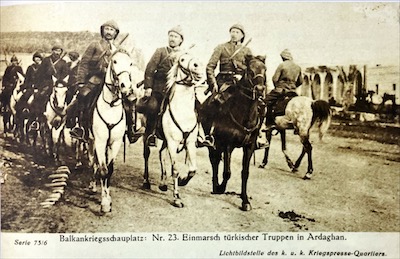
On that same day, the first encouraging news from the Caucasus reached Istanbul: Ardahan had been captured. Having departed Istanbul aboard the warship Yavuz, the Stange Bey Detachment disembarked at Rize, where it was reinforced by nearly two thousand volunteers. Advancing southward, the detachment occupied Ardahan on 27 December 1914. This success was short-lived, however, as the unit, despite its determination, was subsequently overwhelmed by three Russian infantry regiments and one cavalry regiment. Nevertheless, the Stange Bey Detachment demonstrated remarkable resilience, maintaining its position against Russian forces for more than two months before finally withdrawing to its original location on 1 March 1915.
By the evening of 29 December 1914, Turkish forces had taken control of the western outskirts of the town, including the railway station and the barracks of the Russian Yelizavetpolski Regiment. General Prejevalski, the Russian commander in Sarıkamış, now faced a decisive moment and chose to commit his last reserves in a final attempt to drive the Turks out of the town. His chief of staff, Colonel Temrin, displayed notable determination, recapturing the railway station through a bayonet charge. As the balance shifted in their favour, Russian forces compelled the Turkish troops to withdraw from the town, marking a critical turning point in the battle.
On 30 December 1914, the thunder of Russian artillery inflicted heavy losses, casting a grim pall over the battlefield. Confronted with the stark reality, Enver Pasha received two simultaneous reports: one from the chief of staff of the IX Corps, Lieutenant Colonel Şerif Bey, and the other from Colonel Hafız Hakkı Bey. Both conveyed the same message: the corps no longer possessed the strength necessary for another offensive. Despite this, Enver Pasha’s response was unequivocal: “The offensive is to continue at full force.”
As 1914 drew to a close, troubling news arrived from Bardız. The 32nd Division, under intense pressure, had been forced to abandon its positions to advancing Russian troops. With the Bardız and Kızılkilise roads falling into enemy hands, Turkish forces were increasingly confined within a dangerous semi-encirclement. Although a withdrawal through the still-open gap in the encirclement represented the more rational course of action, Enver Pasha rejected caution and instead ordered an attack against the tightening ring.
At the same time, approximately 40 kilometres south of Sarıkamış, the XI Corps under Galip Pasha launched renewed attacks against Russian positions. This effort was intended to relieve pressure on the exhausted IX and X Corps fighting around Sarıkamış. Gradually coming to terms with the gravity of the situation, Enver Pasha shifted his priorities. Abandoning further costly attempts to seize Sarıkamış, he turned his attention to securing lines of retreat. The IX and X Corps were merged into a single formation designated the “Left Wing Army,” with command entrusted to the newly promoted Brigadier General Hafız Hakkı, who was granted the honorary title of Pasha.

Hafız Hakkı Pasha anxiously awaited reinforcements, still clinging to the hope of capturing Sarıkamış. Despite the advancing Russian forces, he refrained from ordering a retreat. As the encirclement tightened, the situation became increasingly desperate. On the afternoon of 4 January 1915, after inspecting the front line on horseback, he returned to headquarters and solemnly declared in French, “Tout est perdu, sauf l’honneur” (“Everything is lost, except honour”). Turning to İhsan Pasha, he added quietly in Turkish, with a faint smile, “It is over.” A final glimmer of hope had persisted for the troops on the Allahüekber Mountains, but none survived.
Soon afterwards, headquarters itself came under Russian fire as the entire 28th Division was taken prisoner. Hafız Hakkı Pasha narrowly escaped capture, but eight senior officers, including İhsan Pasha, were taken captive. The 17th and 29th Divisions suffered the same fate; 108 officers and 80 soldiers were transported to Sarıkamış as prisoners of war. Hafız Hakkı Pasha, having reached the X Corps headquarters, then received news that Russian forces had overrun the IX Corps. Faced with the collapse of the front, he finally ordered a general retreat. At dawn on 5 January 1915, the remnants of the army began their withdrawal towards Erzurum.
It took four days for Enver Pasha and the German officers accompanying him to reach Erzurum. In a telegram sent to Istanbul, he reported: “Although the offensive against the Russians has not resulted in a decisive defeat of the enemy, it has driven them beyond our frontiers, secured parts of their territory, and inflicted damage upon their army. Our immediate priority is to grant the army some respite after fifteen days of uninterrupted fighting, followed by a renewed offensive. As I depart for Istanbul, I entrust command of the army to Hafız Hakkı Pasha. I request that both these developments and my departure be treated with the utmost confidentiality.”
Before leaving Sarıkamış, Enver Pasha addressed the surviving troops: “Friends, for nearly a month I have been with you and witnessed how you attacked the enemy in battles that lasted for days. Despite the severity of the weather, you endured every hardship and broke the enemy’s resistance. You drove the enemy out of the motherland and seized their territory. These efforts will never be forgotten. The entire nation, including the Sultan himself, congratulates you. I am now returning to Istanbul. God willing, you will achieve even greater things, destroy the enemy, and bring peace to the souls of our martyrs. I leave you in God’s protection. Never forget that God is always by our side.”
Enver Pasha, accompanied by his staff, departed Erzurum for Istanbul via Sivas. At the railway station in Ulukışla, he encountered his uncle, Halil Pasha, to whom he conveyed the grim assessment: "The entire force has been lost." Upon reaching Istanbul, Enver Pasha enacted a ban on all publications related to Sarıkamış, citing a patriotic motive to "prevent spies and traitors from demoralising the public through propaganda and lies."
Precise figures for Turkish losses at Sarıkamış remain uncertain. The official history of the Turkish Army estimates total casualties at approximately 60,000 men, drawing partly on Russian sources that reported 7,000 prisoners and 23,000 Turkish fatalities. This figure includes roughly 10,000 deaths in the XI Corps sector and a further 20,000 losses behind the front lines, caused by exposure, disease, and exhaustion rather than direct combat.
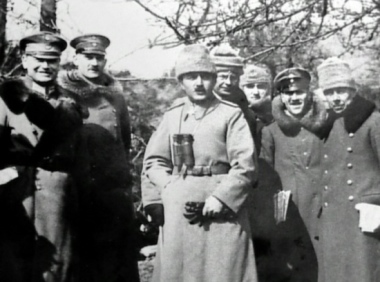
The Sarıkamış tragedy, today often reduced to a narrative centred solely on Enver Pasha, demands a broader and more nuanced assessment of the factors that produced one of the First World War’s most catastrophic military failures. Command errors were undeniably central, yet they were compounded by extreme weather conditions, frost, epidemics, and profound logistical deficiencies. Together, these factors led to the deaths of tens of thousands of Ottoman soldiers in mountainous terrain, many of whom perished without ever engaging the enemy.
Enver Pasha’s responsibility for the outcome is substantial, but attributing the disaster exclusively to him oversimplifies a far more complex reality. His rapid rise through the ranks deprived him of the field experience required to command large formations effectively. This deficiency manifested itself in a limited appreciation of the conditions faced by ordinary soldiers and a persistent neglect of operational and logistical constraints. During the concentration of the Third Army around Erzurum and throughout the campaign, units were ordered to cover extraordinarily long distances in severe winter conditions. The physical limits of the human body were insufficiently considered, making it inevitable that units would fail to meet their marching objectives and ultimately disintegrate. Conducting large-scale operations under such extreme circumstances requires absolute cohesion between commanders and troops; yet even among senior officers, this unity of purpose and resolve was conspicuously lacking.
Enver Pasha and Hafız Hakkı, despite their direct and active involvement in the campaign, failed to anticipate the scale of the difficulties the army would inevitably confront. The ability to reconcile strategic ambition with the practical realities of terrain, climate, logistics, and human endurance proved elusive. As a result, the growing disconnect between senior commanders and rank-and-file soldiers, intensified by the brutal winter conditions, undermined the operational effectiveness of the campaign. A more nuanced assessment of Enver Pasha’s role thus reveals not a single fatal decision, but a complex constellation of miscalculations and structural weaknesses that collectively produced the catastrophe.
The official history of the Turkish Army reaches a clear and revealing conclusion: the fundamental mistake did not lie in undertaking a winter campaign per se, but in the manner in which it was executed. A more carefully planned and coordinated operation, grounded in sound strategic and tactical principles, might have succeeded even under winter conditions. The decisive factor, according to this interpretation, was the resilience and fighting capacity of the Turkish soldier. With better timing and preparation, even Enver Pasha’s original operational vision could have yielded results. Instead, the offensive was launched at a profoundly inopportune moment, triggering a cascade of subsequent errors. Above all, the breakdown in the chain of command stands out as a central factor behind the ultimate failure at the Battle of Sarıkamış.
Against the Russians in East Anatolia
Hafız Hakkı Pasha, commander of the Third Army, died of typhus on 12 February 1915 and was replaced by Brigadier General Mahmut Kamil Pasha, who inherited an army shattered by the winter campaign and ravaged by epidemics. Charged with restoring order, Mahmut Kamil faced the formidable task of rebuilding a force on the brink of collapse. Amid this devastation, faint signs of recovery began to appear as reinforcements gradually arrived from the First and Second Armies. By March 1915, the X and XI Corps could once again be deployed, though each was scarcely stronger than a single division. A reconstituted IX Corps, assembled largely from artillery and support units, was assigned a defensive role.
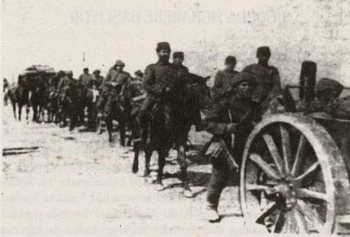
For a brief period, a fragile stability prevailed. Russian forces, having advanced to their pre-war border in the north, consolidated their positions in Turkish towns to the south, Eleşkirt, Ağrı, and Doğubeyazıt. This pause afforded the Third Army a vital opportunity to recover, reorganize, and establish new defensive lines. Yet the available forces remained insufficient to secure the entirety of East Anatolia.
With the arrival of milder weather, the strategic balance shifted once more. On 6 May 1915, the Russian army launched an offensive through the Tortum Valley toward Erzurum. The Turkish 29th and 30th Divisions succeeded in halting the advance, after which the X Corps mounted a counter-attack in an attempt to regain lost ground. By 13 June 1915, Russian units were compelled to withdraw to their original positions, illustrating the fluctuating fortunes of the campaign.
In the southern sector of the Caucasian theatre, however, the situation unfolded far less favourably for the Ottomans. On 11 May 1915, Malazgirt fell to Russian forces, and on 17 May 1915, Russian troops entered Van, steadily pushing Turkish units back. Supply lines were disrupted, while Armenian uprisings further compounded the crisis. South of Lake Van, the Ottomans were tasked with defending a 600-kilometre front with barely 50,000 men and 130 artillery pieces. Vastly outnumbered and operating in difficult mountainous terrain, Turkish forces struggled to maintain a coherent defence.
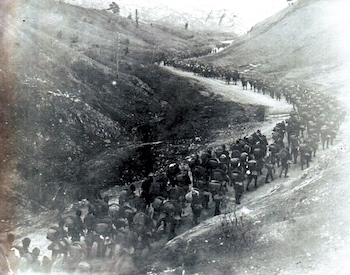
Come 19 June 1915, the Russians initiated another offensive, this time toward the northwest, aiming for Lake Van. Russian forces advanced from Malazgirt toward Muş, unaware of the movement of the Turkish IX Corps, accompanied by the 17th and 28th Divisions. Despite difficult conditions, the Turks reorganised effectively, positioning the 1st and 5th Expeditionary Forces south of the Russian axis of advance. A “Right Wing Group” under Brigadier General Abdülkerim Pasha, reporting directly to Enver Pasha, further strengthened the defensive posture. The stage was thus set for a Turkish response to the impending Russian attacks.
The Russian offensive was halted by 16 July 1915, as the IX Corps approached from the northwest and linked up with the newly arrived 5th Expeditionary Force. Acting in concert, these units pursued the retreating Russians, culminating in the liberation of Malazgirt on 26 July 1915. Achieved at considerable cost, with heavy casualties, this success nonetheless proved pivotal, significantly boosting Turkish morale amid continuing adversity.
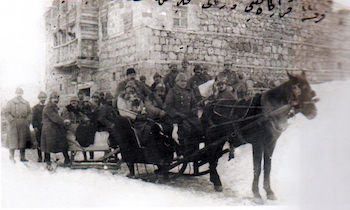
Following this notable victory, Abdülkerim Pasha immediately telegraphed Istanbul, requesting permission to continue the offensive. Enver Pasha, elated by the developments, encouraged him to press the attack toward Eleşkirt and Karaköse, with the aim of expelling all Russian forces from the border region.
By 5 August 1915, the Right Wing Group had advanced some 20 kilometres into Russian territory. However, the left wing of the IX Corps remained dangerously exposed, as Abdülkerim Pasha repeated a critical mistake reminiscent of Sarıkamış, committing all available forces to the offensive without retaining any reserves. The Russians quickly identified this weakness and launched a counterattack. Although the 29th Division rushed to provide support, the Turkish offensive formation faced imminent encirclement. With no viable alternative, Abdülkerim Pasha ordered a retreat, leading to the recapture of Malazgirt by Russian forces. Hostilities subsided by 15 August 1915, leaving behind a grim toll: 10,000 Turkish soldiers killed and 6,000 taken prisoner.
While the reorganisation of Turkish forces in East Anatolia during the spring of 1915 constituted a notable achievement, the renewed sense of momentum ultimately proved futile. Casualties had been so severe that the IX Corps could no longer restore its strength through reinforcements, while both the X and XI Corps remained structurally weakened. The Russians, too, had suffered significant losses. As a result, the Caucasian front descended into relative silence for the remainder of the year, the thunder of artillery giving way to an uneasy calm.
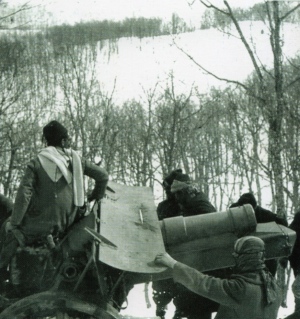
The Ottoman High Command struggled to compensate for the immense losses sustained by the Third Army. The pressing demands of the Gallipoli campaign siphoned off critical manpower and material resources, leaving the IX, X, and XI Corps devoid of reinforcements. This strain was further exacerbated by the redeployment of the 1st and 5th Expeditionary Forces to Mesopotamia. With the Caucasian front downgraded to secondary importance, the once-formidable Third Army was left dangerously enfeebled.
By January 1916, the Third Army numbered 126,000 personnel in total, of whom only 50,539 were infantry. Its armament consisted of 74,057 rifles, 77 machine guns, and 180 artillery pieces. Opposing them stood a powerful Russian force of approximately 200,000 men supported by 380 artillery guns. The IX, X, and XI Corps adopted defensive positions along the Erzurum road, centred on Köprüköy. This deployment rested on a critical and ultimately mistaken assumption: that the Russians would refrain from launching a winter offensive.
That assumption was shattered on 10 January 1916, when Russian General Yudenich launched a sweeping winter offensive, catching the Turkish Third Army entirely unprepared. At this crucial moment, Third Army commander Mahmut Kamil Pasha was on leave in Istanbul, while the chief of staff, Colonel Felix Guse, was recovering from typhus in Germany. The initial Russian assault focused on the XI Corps, breaking through Turkish defensive lines in just four days. In the aftermath, Turkish forces abandoned the Köprüköy positions, and by 18 January 1916, Russian troops had reached Hasankale, a key town on the road to Erzurum, forcing the Third Army headquarters to shift its centre of gravity amid mounting pressure.
Within the span of a single week, the Turkish defensive system collapsed. Losses amounted to approximately 10,000 casualties, with an additional 5,000 soldiers taken prisoner. Sixteen artillery pieces were lost, and nearly 40,000 men withdrew into the confines of Erzurum Fortress. The XI Corps bore the brunt of this disaster, suffering especially heavy casualties. At the same time, Russian commanders turned their attention toward Erzurum itself, a formidable stronghold and the Ottoman Empire’s second most heavily fortified city after Edirne.
Returning from Istanbul on 29 January 1916, Third Army commander Mahmut Kamil Pasha quickly grasped the gravity of the situation. He anticipated not only a direct Russian assault on Erzurum but also a renewed offensive in the Lake Van region. With the fortress threatened from both the north and the east, Mahmut Kamil Pasha ordered urgent measures to reinforce the defensive perimeter.
By 11 February 1916, Russian artillery opened sustained fire against the fortified positions encircling Erzurum, triggering intense fighting. Turkish battalions, reduced to roughly 350 men each, resisted Russian units numbering close to 1,000. Despite their numerical superiority, Russian forces required several days of hard fighting before securing the dominant heights overlooking the Erzurum plain. Within three days, the situation became untenable. The Third Army command concluded that Erzurum could no longer be held. A general withdrawal was ordered from the outer fortifications, accompanied by the evacuation of the city itself.
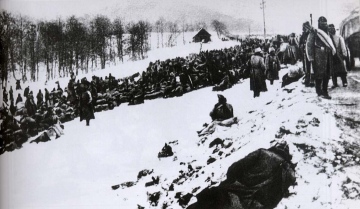
On the cold morning of 16 February 1916, Russian troops entered Erzurum. Although Turkish units managed to withdraw in relatively good order and avoided complete encirclement, the material and human losses were severe. A total of 327 artillery pieces fell into Russian hands, along with numerous support units of the Third Army. Approximately 250 wounded soldiers, left behind in Erzurum’s military hospital, were taken prisoner. Meanwhile, the remnants of the X and XI Corps regrouped and established a new defensive line some eight kilometres east of Erzurum, attempting once more to stabilise the collapsing front.
Amid the lingering jubilation generated by the recent victory at Gallipoli, public optimism in Istanbul was abruptly tempered by reports from the Eastern Front and the loss of Erzurum. In response, Enver Pasha promptly ordered the redeployment of the V Corps comprising the 10th and 13th Divisions to reinforce the embattled Caucasian front. On 27 February 1916, he relieved Mahmut Kamil Pasha of command and appointed Vehib Pasha, then commander of the Second Army and widely regarded as one of the foremost commanders of the Gallipoli campaign. Assuming command of the Third Army, Vehib Pasha arrived in Erzincan, which had become the new operational headquarters, on 16 March. His immediate task was to restore discipline and cohesion within an army reduced to approximately 25,500 men, supported by only 76 machine guns and 86 serviceable artillery pieces. The fall of Erzurum thus represented not merely a territorial setback, but also the loss of vital medical facilities and logistical infrastructure.
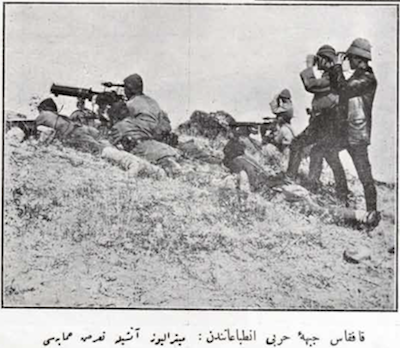
Recognizing that the weakened Third Army was incapable of defending the front independently, Enver Pasha ordered the redeployment of the Second Army, then stationed in Thrace under the command of Ahmet İzzet Pasha. The Second Army was tasked with advancing toward Diyarbakır in southeastern Anatolia in order to reinforce the eastern sector held by the Third Army. By August 1916, it was planned that the Second Army would field four corps and ten divisions, significantly strengthening Ottoman defensive capacity in the region.
At the same time, Russian forces advanced with notable speed and operational efficiency. In March 1916, Russian units landed at Rize, a strategically significant port on the eastern Black Sea coast, and rapidly advanced westward, capturing Trabzon on 16 April 1916. This development posed a serious strategic challenge for the Third Army, which was effectively cut off from Black Sea supply routes and reinforcements. These difficulties were compounded by delays in the movement of the Second Army, as limited railway capacity forced the Ottoman High Command to prioritize the transportation of units bound for the Mesopotamian front.
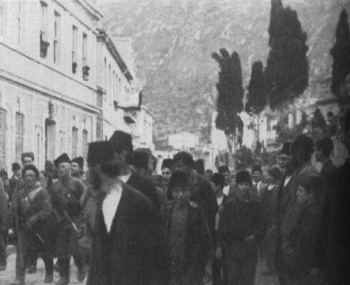
Confronted with these mounting pressures, Vehib Pasha reorganized the front into three distinct operational sectors. The southeastern sector, extending north of Diyarbakır, was placed under the command of Mustafa Kemal Pasha’s XVI Corps. The central sector was entrusted to Yusuf Ziya Pasha’s X Corps, supported by the IX and XI Corps and the 2nd Cavalry Division. The northern sector, encompassing the Black Sea coastline, was assigned to Fevzi Pasha’s V Corps.
In the closing days of June, Fevzi Pasha’s V Corps launched an offensive into the Eastern Black Sea Mountains with the objective of recapturing the port of Trabzon, which the Russians were using as a vital maritime supply hub. Although the operation achieved limited tactical successes, the primary objective could not be realized due to insufficient forces. By 28 June 1916, Turkish units had advanced approximately ten kilometres toward the coast but were ultimately compelled to halt in the face of determined Russian resistance.
Concurrently, Russian forces initiated a counteroffensive designed both to relieve pressure on Trabzon and to threaten the strategically important city of Sivas. Known as the Çoruh Campaign, this operation began on 2 July 1916. As Russian troops approached Bayburt, they encountered stiff resistance from the Turkish X Corps. Despite determined defensive efforts, Turkish forces were unable to hold their positions, and Bayburt fell to the Russians on 17 July 1916.
Exploiting Bayburt as a forward base, Russian forces launched further attacks, crossing the Karasu River and compelling the Turkish IX and X Corps to retreat. On 25 July 1916, advanced Russian units entered Erzincan. Faced with the risk of encirclement and lacking viable defensive options, Vehib Pasha evacuated the city and withdrew westward in an effort to slow further Russian penetration into Anatolia. The Çoruh Campaign lasted twelve days and resulted in the loss of key urban centres, as well as approximately 17,000 Turkish fatalities and a comparable number of prisoners of war.
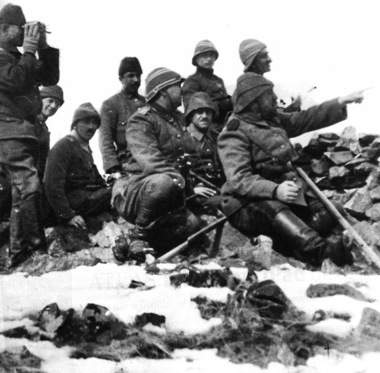
Following this severe setback, Ahmet İzzet Pasha nevertheless resolved to launch a counteroffensive one week after the conclusion of the Russian advance. The Second Army was tasked with relieving the embattled Third Army and recapturing Erzincan. Beginning on 2 August 1916, the Ottoman offensive was conducted through three corps-level formations: the III, IV, and XVI Corps. In the initial phase, Mustafa Kemal Pasha’s XVI Corps achieved notable successes, capturing Bitlis and Muş. These gains, however, proved insufficient to secure a decisive outcome, as Russian forces rapidly reinforced their defensive positions.
Within two weeks of the Ottoman advance, Russian counteroffensives were launched, coinciding with mounting logistical and supply difficulties on the Turkish side. By late September 1916, the Ottoman offensive had come to an end. Although some territorial gains were achieved, they came at a considerable cost, with Turkish casualties reaching approximately 30,000 men.
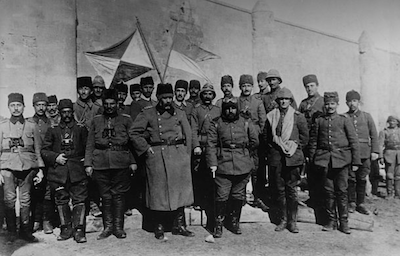
The remainder of 1916 was marked by organizational restructuring and operational consolidation by Ottoman forces on the Caucasian front. During this period, Russian forces largely remained inactive. The exceptionally severe winter of 1916–1917 rendered sustained military operations virtually impossible, a condition that persisted well into the spring. Concurrently, Russia was engulfed in profound political and social upheaval, culminating in the October Revolution, which effectively paralysed military command structures and precipitated the withdrawal of Russian forces from the front. Neither Russian soldiers nor the civilian population displayed any inclination to continue the war.
Despite the strategic opportunity presented by the Russian collapse, Ottoman forces were unable to exploit the situation due to their own structural and manpower deficiencies. Compounding these difficulties, increasing pressure from British forces in Palestine and Mesopotamia compelled the Ottoman High Command to redeploy the majority of its remaining units (five divisions in total) to the southern theatres. As a result, the year 1917 passed without major military engagement on the Caucasian front. The Russian army continued to disintegrate steadily, ultimately ceasing to function as a coherent fighting force. Hostilities formally ended with the signing of the Armistice of Erzincan on 16 December 1917, which officially brought the Caucasian campaign to a close.
Recapturing Lost Territories
In the aftermath of the armistice concluded between the Russians and the Ottomans, the Imperial Russian Army began withdrawing from Anatolian territory. Nevertheless, violence and instability persisted in the region. On 4 February 1918, Vehib Pasha, commander of the Ottoman Third Army, formally communicated with his Russian counterpart, declaring his intention to initiate an offensive aimed at preventing Armenian attacks against the Muslim population in areas evacuated by Russian forces.
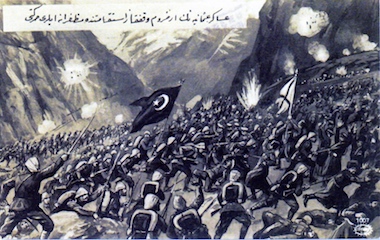
Vehib Pasha’s assessment was informed by a detailed intelligence report prepared by Lieutenant Hüsamettin Bey, who had escaped from Russian captivity and made his way to Trabzon. According to this report, the remnants of the Russian Army were no longer capable of maintaining the frontier line. British and French representatives were actively assisting in the formation of Armenian and Georgian military units, while Armenian forces supported by Russian Bolsheviks were pursuing plans to expel Muslim Azerbaijanis from much of the southern Caucasus.
At the same time, Enver Pasha was developing a broader strategic vision in Istanbul. Viewing the Russian Revolution as a historic opportunity, he sought not only to recover the pre-war Ottoman frontiers but also to reclaim territories lost to Russia during the 1877–1878 war. These territorial gains were envisioned as a springboard for extending Ottoman influence into Central Asia. Accordingly, reinforcements were ordered to the Third Army, and preparations for a major offensive were accelerated.
The Ottoman offensive commenced on 5 February 1918, advancing eastward from the line stretching between Tirebolu and Bitlis. Executed with speed and coordination, Third Army units rapidly retook territories previously lost to Armenian forces. Kelkit was recaptured on 7 February, followed by Erzincan on 13 February, Bayburt on 19 February, and Tercan on 22 February. The strategic Black Sea port of Trabzon was reclaimed on 25 February 1918, significantly strengthening Ottoman combat capabilities through the arrival of reinforcements by sea.
Armenian forces attempted to hold the city of Erzurum but were overcome by the Turkish I Caucasian Corps on 12 March 1918. Successive victories followed, with Malazgirt, Hınıs, Oltu, Köprüköy, and Tortum falling over the next two weeks. The momentum of these operations shifted the balance in the region, marking pivotal chapters in the unfolding history of the war.
Treaty of Brest-Litovsk
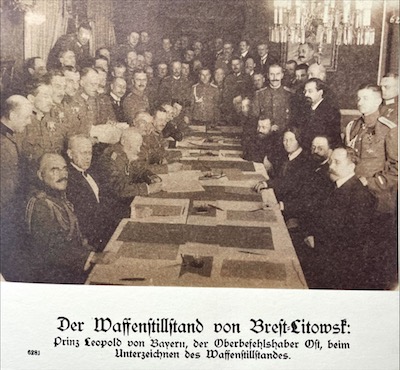
As the Ottoman Empire sought to reclaim lost territories, peace discussions unfolded between Russia and the Central Powers in Brest-Litovsk (present-day Belarus). The treaty, signed on 3 March 1918, mandated the return of specific regions, i.e. Ardahan, Kars, and Batumi, acquired by Russia from the Ottoman Empire during the 1877–1878 war. However, with the timing and method of restoration unclear, and these areas already vacated by Russian forces, Armenians assumed control of Kars and Ardahan, while Georgians occupied Batumi.
On 14 March 1918, the Ottoman government initiated negotiations with representatives of the newly-formed Transcaucasian Federation (Mâvera-yi Kafkas Konfederasyonu) to establish peace conditions in the Caucasus. Insisting on strict adherence to the Brest-Litovsk terms, the Ottoman delegation faced resistance from Armenian and Georgian officials, who sought concessions, particularly to retain Kars and Batumi. Meanwhile, Turkish forces advanced toward these contested towns as discussions unfolded in Trabzon.
The talks reached an impasse, prompting Enver Pasha to instruct Vehib Pasha to use military measures to enforce the Brest-Litovsk terms. Strategically, Batumi was emphasized as a gateway to the Caucasus, Persia, and Central Asia. Enver Pasha aimed first to secure Muslim populations in the Caucasus before considering operations further east into Central Asia.
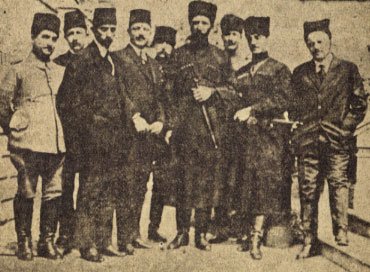
While Enver Pasha prioritized the protection of Muslims in the Caucasus, Vehib Pasha, exercising caution, feared that such an operation might unite Armenians and Georgians against local Muslims. He also doubted the feasibility of securing the region with the available forces, anticipating potential anarchy. Despite his reservations about Enver’s plans, Vehib Pasha had no choice but to proceed with preparations.
In a letter from Istanbul, Enver Pasha asserted: “As the reward for three years of bloodshed and hardship, it is the government’s duty to physically reclaim Batumi, Kars, and Ardahan, territories lost by the Ottoman Empire in the past but secured by the Brest-Litovsk treaty.”
Vehib Pasha devised a three-pronged offensive plan. The Şevki Pasha Group, comprising the I and II Caucasus Corps and the 5th Infantry Division under Yakup Şevki Pasha, would advance toward Kars in the centre. Along the Black Sea coast on the left, the VI Corps was to move toward Batumi, while the IV Corps on the right would launch an attack toward Van and Doğubayazıt.
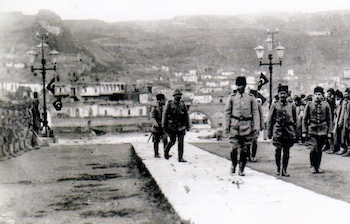
The offensive began, though the troops were already in motion, on 3 April 1918, when Ardahan was liberated by the Şevki Pasha Group. In pursuit, the 9th Caucasus Division tracked the retreating Armenian forces to Sarıkamış, site of a poignant tragedy three years earlier, which was seized on 5 April 1918. Colonel Kazım Bey, commanding the I Caucasus Corps, relentlessly pursued Armenian units. By 8 April 1918, Kağızman had been liberated, marking the commencement of the advance toward Kars in accordance with Yakup Şevki Pasha’s directive to Kazım Bey.
The march toward Selim, a town staunchly fortified by the Armenians, saw the 9th and 36th Divisions in action. A temporary halt on 11 April 1918, prompted by news from the ongoing conference in Trabzon, suggested that the Transcaucasian Federation representatives had ostensibly agreed to the evacuation terms of the Brest-Litovsk treaty. Recognizing this as a ruse to buy time, the advance toward Kars resumed the next day. After four days of intense struggle, Selim fell on 22 April 1918, paving the way for the next chapter in Kars’ fate.
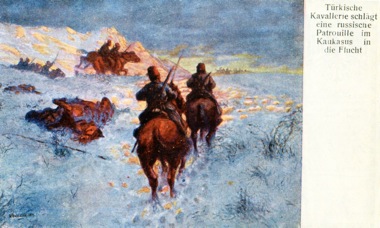
the Russian patrol • Başar Eryöner collection
Back in 1915, following their triumph over the Turks at Sarıkamış, the Russians had strategically fortified Kars. The meticulous defenses ensured that even if the Turks managed to capture the city, victory would come at a heavy cost. Understanding this, Kazım Bey opted to lay siege rather than risk a direct assault. The siege began on 23 April 1918, orchestrated by the I and II Caucasus Corps.
Swiftly, the Armenian officers acknowledged the inevitability of their situation. Facilitated by French intermediaries, General Nazarbekov, stationed in Yerevan, sought a ceasefire. The Turkish response was clear: only the unconditional surrender of the city would suffice. With limited alternatives, the Armenian officers acquiesced. On 25 April 1918, Captain Talat Bey assumed control of the city from General Deyev. Simultaneously, the surrounding batteries were seized, and by evening, a regiment from the I Caucasus Corps had taken command. The following day, at 10:00 am, Colonel Kazım Bey personally entered Kars as its “Liberator.”
"After 40 years of enslavement, the Fortress of Kars and all those hands were joining back the motherland. I spread the good news and celebrations began everywhere. It was a great joy for me that it was my corps, which had liberated Erzincan and Erzurum in the dead of winter, to have the honor of raising the Turkish flag over Kars. This was my greatest ideal since I was a child." (Col. Kazım Bey in his memoirs)
On the other flanks, Turkish operations were also progressing successfully. Traversing the Black Sea coast, the 123rd Regiment from Trabzon reached Çayeli on 2 April 1918, shortly after the 37th Caucasus Division liberated Artvin and Andanuç. The latter’s primary objective, Batumi, was seized after two days of combat on 14 April. Simultaneously, the IV Corps advanced to Van on 6 April, discovering the grim fate inflicted on the local Muslim population by Russian forces. Doğubayazıt fell to Turkish control a week later.
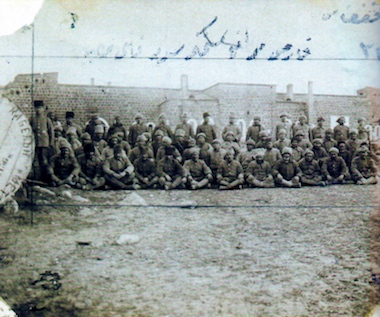
While Turkish units pushed eastward, peace talks resumed on 11 May 1918 in Batumi. Despite ongoing negotiations, military operations continued. The refusal of the Transcaucasian authorities to grant access to regional railways, necessary to counter British influence in northern Persia, prompted Yakup Şevki Pasha to advance, capturing Gyumri on 15 May 1918 and Karakilise on 28 May 1918, while clashing with Georgian forces in Akhaltzikhe and Gyumri.
In Batumi, Turkish negotiators, led by Halil Bey, maintained a firm stance. They insisted on the establishment of independent states within the Transcaucasian Federation for all ethnic groups, asserting that peace would be unattainable otherwise. The Azerbaijanis aligned with the Ottoman position, while Armenians and Georgians, divided internally, sought to halt the Turkish advance. On 26 May 1918, the Transcaucasian Democratic Federative Republic formally dissolved, giving rise to three independent states: the Democratic Republic of Georgia, the Democratic Republic of Armenia, and the Azerbaijan Democratic Republic. Separate peace treaties were signed between the Ottoman government and each republic on 4 June 1918.
On 5 June 1918, a meeting between Enver Pasha and German representatives in Batumi escalated tensions due to an unexpected incident. Vehib Pasha’s troops, advancing along the main road to Tbilisi, encountered a joint Georgian-German unit. A clash ensued, during which Turkish forces successfully engaged the adversaries and captured several prisoners, including German personnel.
Army of Islam
In response to German pressure, Enver Pasha halted further Turkish expansion into Georgia, yet he remained steadfast in pursuing his pan-Turkic ambitions. On 8 June 1918, he ordered a comprehensive reorganization of Turkish forces in the region. The Third Army gave rise to a newly formed Ninth Army, placed under the command of Yakup Şevki Pasha. Simultaneously, the Eastern Army Group, originally led by Vehib Pasha and later replaced by Halil Pasha, coordinated the operations of both the Third and Ninth Armies. Esat Pasha assumed command of the Third Army.
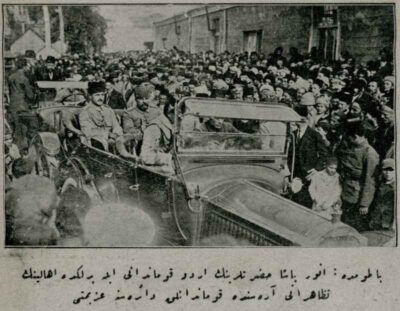
With a northward advance no longer viable, Enver redirected his strategic focus eastward and southward, toward Azerbaijan and Persia. By March 1918, he had envisioned an "Army of Islam," designed to mobilize Muslim supporters across the Caucasus and advance through Persia to confront British forces in Mesopotamia. On 10 July 1918, this force comprising the 5th Caucasus Infantry Division, the 15th Division, an independent brigade, and a regiment under Nuri Pasha was formally activated. Its headquarters were established in Gence, the capital of the newly formed Azerbaijan Democratic Republic.
The Army of Islam’s principal objective was the liberation of Muslim Azerbaijanis from Armenian and Russian oppression, with the ultimate goal of securing the strategic city of Baku. Following the October Revolution, a local Soviet government had emerged in Baku, using the pretext of protecting local Armenians to justify incursions into Azerbaijani territory. In reality, their aim was to suppress the independence of the Azerbaijan Democratic Republic, relying on a formidable joint force of 32 Russian and Armenian regiments for support.
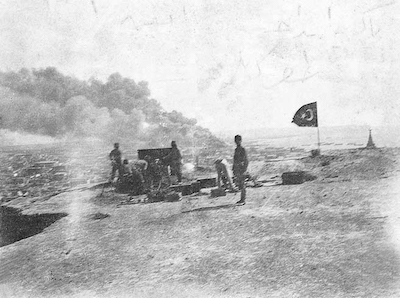
In the wake of confrontations near Baku, the Army of Islam launched its first assault on the city on 31 July 1918. Shortly beforehand, a coup d'état had ousted the Bolsheviks in Baku, establishing a new administration known as the Central Caspian Dictatorship. Supported by the British, this government commanded roughly 1,500 British troops among its forces.
The Turkish offensive continued until 2 August 1918, when it was called off. A subsequent attempt on 5 August 1918 also failed to achieve its objectives. Confronted with counterattacks from Russian, Armenian, and British forces, the Army of Islam was forced to retreat westward.
Amidst declining morale, the Army of Islam sustained heavy losses, leaving only 3,500 combat-ready troops. While provisions of food and water remained sufficient, ammunition stocks had become critically low. In response, Nuri Pasha urgently telegraphed the Third Army headquarters, requesting reinforcements including 5,000 fresh soldiers, four artillery batteries, airplanes, 28,000 artillery shells, 1,500 boxes of rifle bullets, and 20 transport vehicles, resources deemed indispensable for mounting a renewed offensive against Baku.
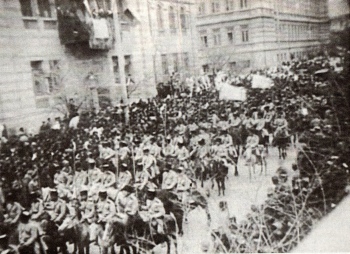
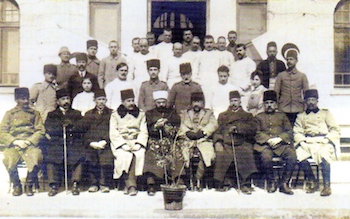
Nuri Pasha, in his report to Enver Pasha, highlighted that street clashes occurred between Muslim and Armenian populations during the Battle of Baku. While Armenians and a few Russians lost their lives, the casualties were far fewer than the Muslims massacred in Baku in March 1918.
Another area of danger for the Muslim population was Karabakh. The 1st Azerbaijan Division, formed under Colonel Cemil Cahit Bey and fully combat-ready by 6 October 1918, secured the Askeran Pass, expelling Armenian forces and ensuring the safety of approximately 20,000 Azerbaijani Turks in Susha. On 8 November 1918, Azerbaijani General Yusufov assumed command as Istanbul prepared for armistice negotiations with the Allied powers, signaling an end to Turkish military operations in the region.
After the capture of Baku, Nuri Pasha turned his attention to Dagestan, where the Muslim population faced oppression by Bolshevik forces. The Northern Caucasus Army, composed of the 15th Infantry Division and Dagestani militia under Yusuf İzzet Pasha, launched an offensive to seize Derbent and Petrovsk.
The operation began on 5 October 1918, but fierce resistance forced a temporary halt. When the advance resumed on 20 October, Derbent fell on 26 October, followed by Petrovsk on 8 November, marking the final Turkish offensive of the First World War.
The Armistice of Mudros, signed on 30 October 1918, formally ended hostilities for the Ottoman Empire. By the conclusion of the war, despite setbacks in Palestine and Mesopotamia, the Ottomans had successfully reclaimed all territories lost to Russia in Eastern Anatolia.
The Caucasus campaign of the First World War epitomizes both the extremes of human endurance and the consequences of strategic misjudgment. From the devastating losses at Sarıkamış, where harsh winter, logistical failures, and epidemics decimated the Ottoman Third Army, to the hard-fought recoveries of Erzurum, Erzincan, and Kars, the conflict showcased immense courage and resilience amid adversity. Despite early setbacks, commanders like Vehib Pasha, Kazım Bey, and Nuri Pasha guided Ottoman forces to reclaim lost territories, protect Muslim populations in Azerbaijan, and secure strategic positions in Dagestan, culminating in the final successes shortly before the Armistice of Mudros. The campaign underscores the interplay of ambition, operational challenges, and human sacrifice, leaving a legacy of tragedy and triumph that shaped the eastern frontiers of the Ottoman Empire and the memory of its soldiers.

PAGE LAST UPDATED ON 17 JANUARY 2026