
On the eve of the First World War, the Ottoman Army entered the conflict as one of the most poorly equipped forces among the major belligerents. Decades of financial mismanagement, military defeat, and industrial underdevelopment had left it chronically dependent on foreign suppliers for virtually every category of weapon, from rifles and artillery pieces to machine guns and grenades. The empire possessed no meaningful domestic arms industry of its own. Zeytinburnu Munitions Plant in Istanbul could produce small quantities of rifle ammunition, but it was wholly incapable of meeting the demands of large-scale modern warfare. What the Ottoman Army carried into battle had been purchased, borrowed, or received as grants from Germany and Austria-Hungary, and it came in a bewildering variety of models, calibers, and vintages that posed severe logistical challenges throughout the war.
This dependence had deep roots. It was Sultan Abdülhamit II who first recognized, in the late nineteenth century, that the army's weapons had fallen dangerously behind those of the European powers. The industrial revolution had transformed warfare, and the Ottoman military was still equipped with the tools of an earlier era. The reform process he initiated began a long and costly effort to modernize the army's arsenal, primarily by purchasing weapons from Germany. That relationship, forged in the 1880s and deepened through military missions, railway concessions, and economic ties, would define Ottoman military supply throughout the World War.
Rifles
- The Ottoman Army entered the First World War with a large but highly diverse rifle arsenal, including Peabody-Martinis, Winchesters, and several Mauser models, creating major supply and maintenance challenges.
- The Peabody-Martini, adopted in the 1870s, performed effectively during the Russo-Turkish War and remained in frontline and secondary service long after more modern rifles were introduced.
- Successive Mauser models (M1887, M1890, M1893, and M1903) modernized Ottoman infantry firepower, with the M1893 becoming the most widely used rifle during the Gallipoli campaign.
- Ammunition supply was a constant concern, as domestic production could not meet wartime demand, forcing the Ottoman Empire to rely heavily on large-scale German ammunition shipments.
The rifle arsenal of the Ottoman Army in 1914 was the product of nearly four decades of piecemeal modernization, successive procurement contracts, and the accumulated residue of earlier wars. It was diverse to an extent that would have been the envy of no quartermaster, as Ottoman soldiers went into battle carrying weapons manufactured across three continents, in at least half a dozen calibers, spanning a production history of forty years. The logistical consequences of this diversity were severe and persistent throughout the war.
The Peabody-Martini and Early Modernization
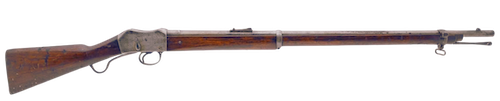
Before the Mauser program began, the standard infantry rifle of the Ottoman Army was the Peabody-Martini, a lever-actuated falling-block single-shot rifle produced for the Ottoman Empire by the Providence Tool Company of Rhode Island, USA. The Ottoman government had initially sought to purchase the British Martini-Henry but was refused, and turned instead to Providence Tool, which held the rights to the Peabody falling-block action and had incorporated the Martini improvement to it. The original contract, placed in urgent response to the threat of war with Russia in the mid-1870s, was for over 600,000 rifles and carbines. The weapon proved its worth almost immediately. During the Russo-Turkish War of 1877–1878, the accurate and rapid fire of Ottoman troops armed with the Peabody-Martini at the siege of Plevna inflicted devastating casualties on Russian assault columns and delayed the Russian advance on Istanbul for months, making a strong impression on military observers from across Europe.
The rifle that distinguished itself at Plevna was chambered for a .45-inch cartridge and fitted in its first production pattern with a socket bayonet and a safety catch; a later pattern eliminated the safety and was issued with a sword bayonet instead. Over the service life of the weapon, a significant number were eventually re-barreled to accept the 7.65 mm Mauser cartridge, a conversion carried out around the time of the First Balkan War in 1912, allowing them to share ammunition with the newer Mauser rifles. Examples captured by British and Commonwealth forces at Gallipoli and in Mesopotamia confirmed that Peabody-Martini rifles in both their original caliber and converted form were still in frontline use as late as 1915 and 1916, a testament both to the weapon's durability and to the Ottoman Army's shortage of more modern replacements.
The Mauser Program: M1887 to M1890
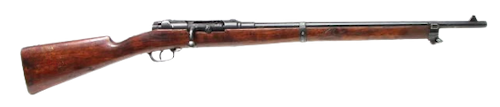
The modernization of Ottoman infantry weapons in the Mauser era began with a contract that gave the Turkish government an unusually favorable clause. It could redirect production to any new Mauser model introduced for another customer, effectively allowing the army to keep pace with the latest designs without signing an entirely new agreement. The first deliveries under this arrangement were of the Model 1887 (M1887), a rifle derived from the German Gewehr 71/84 and chambered for a 9.5 x 60R black powder cartridge. The M1887 was notable for its eight-round tubular under-barrel magazine, a design already falling out of favor as European armies moved toward box magazines, and for the fact that its cartridge, though considered the finest black powder military round of its era, was effectively obsolete from the moment of its adoption. France had introduced smokeless powder ammunition in 1886, and the rest of Europe was rapidly following. Mauser delivered approximately 220,000 M1887 rifles to the Ottoman Empire before the contract clause was invoked and production was redirected.

The replacement was the Model 1890 (M1890), a far more significant weapon. Derived from the Belgian Model 1889 Mauser, it was chambered for the new 7.65 x 53 mm smokeless cartridge, a substantial improvement in velocity, accuracy, and barrel wear compared to the black powder M1887. Approximately 280,000 M1890 rifles were delivered. The rifle's design introduced the box magazine that would characterize all subsequent Ottoman Mausers, and its adoption of smokeless powder brought the Ottoman infantry into line with the leading European armies of the period. Surviving M1887 rifles that remained in service were eventually rebuilt and re-barreled to fire the same 7.65 mm round, standardizing the ammunition supply across the older and newer weapons.
The M1893 and M1903

The most widely used Mauser variant in Ottoman service was the Model 1893 (M1893), of which approximately 201,000 were produced by the Oberndorf Mauser works. Developed from the Spanish Model 1893, the Ottoman version incorporated a magazine cutoff device not found on the Spanish original, allowing the soldier to use the rifle as a single-shot weapon while keeping rounds in the magazine in reserve. It was 122.5 cm in length, weighed 4 kg, and was fed by a flush-fitting five-round staggered-column box magazine loaded from above with a stripper clip. The cartridge was the 7 x 57 mm Mauser round, fired at a muzzle velocity sufficient to give the weapon an effective range well beyond 500 meters. The M1893 was the most common rifle in Ottoman hands at Gallipoli in 1915, where it was encountered and captured by Australian, New Zealand, and British forces. Captured examples were sometimes put back into service by Allied troops, as the 7.65 mm cartridge was compatible with Belgian Mauser rifles already in circulation on the Allied side.

In the early 1900s, the Ottoman government placed another major order, this time for the Model 1903 (M1903), a modified version of the German Gewehr 98, which was itself the most advanced bolt-action military rifle in the world at the time of its adoption. The Ottoman M1903 differed from the German original in several respects: the long-range Lange Visier sight was replaced by a simpler tangent leaf sight, the nose cap was simplified, and a distinctive high-humped receiver bridge was added to guide the stripper clip into the magazine. It also retained an extended bolt-stop lever unique to the Ottoman variant. Approximately 175,000 to 200,000 were produced by Waffenfabrik Mauser AG at Oberndorf between 1903 and 1909, chambered in 7.65 x 53 mm. The accompanying Model 1905 carbine, a shortened version of the M1903 measuring 105.6 cm and weighing 3.6 kg, was produced for cavalry and artillery units and also saw widespread use.
The Peabody-Martini's American Cousin: The Winchester

Alongside the Peabody-Martini, the Ottoman cavalry had also been equipped with Winchester lever-action carbines, an American weapon of an entirely different design philosophy. The Winchester used a lever-operated action with a tubular magazine under the barrel, optimized for rapid fire at close to medium range. It was well suited to cavalry use, being lighter and shorter than a full-length infantry rifle, but its rimmed cartridge design was incompatible with the box-magazine Mausers that came to dominate the infantry, creating a secondary ammunition supply problem for mounted units.
The Arsenal at the Outbreak of War
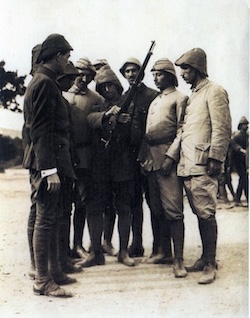
By the time the Ottoman Empire entered the First World War in November 1914, the total infantry rifle inventory stood at approximately 1.5 million pieces. The backbone was the Turkish Mauser family in its various models: the M1887, M1890, M1893, and M1903, all chambered for the 7.65 x 53 mm cartridge, along with carbine variants of the M1903 and M1905 issued to cavalry and support units. Germany supplied Gewehr 98 rifles during the war itself, adding a second caliber to the Mauser inventory: the 7.92 x 57 mm round standard in the German Army. Austria-Hungary contributed adapted Mosin-Nagant M1891 rifles, originally Russian weapons captured on the Eastern Front and reworked for Ottoman use. There were also small numbers of British Lee-Enfields, French Lebels, and various Balkan army rifles, all taken as battlefield captures from the wars of 1912 and 1913. Bayonets for the Mauser rifles were produced by specialist manufacturers in Solingen and Suhl, the traditional centers of the German cutlery and metalworking trades.
The older Peabody-Martini and Winchester weapons, while technically obsolete, were never fully withdrawn from service. They remained in use throughout the war, particularly in rear-area garrison duties and in the hands of irregular and tribal forces, where the precise logistical standard required for frontline units was less critical.
Ammunition Supply
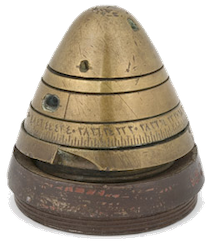
The ammunition supply for this vast and diverse rifle arsenal was a source of chronic anxiety throughout the war. Domestic production at the Zeytinburnu Munitions Plant was structurally insufficient. Large contracts were placed with German manufacturers before the war: Deutsche Waffen und Munitions Fabrik in Karlsruhe received an order for 250 million battle cartridges and 10 million training cartridges, while a further 50 million battle cartridges were ordered from the firms of Erhart and Polne. The total cost of this pre-war procurement reached 1.7 million golden liras, of which 15 percent was paid upfront and the rest in installments at six percent annual interest. By 1912, the combined stockpile of imported and domestically produced cartridges had reached approximately 886 million rounds, a figure that seemed adequate on paper but proved dangerously strained once fighting began simultaneously in the Caucasus, Mesopotamia, Gallipoli, and Palestine. Over the course of the entire war, Germany supplied an additional 930 million rifle cartridges to the Ottoman Army, without which several fronts could not have been sustained.
Blades: Bayonets, Swords, and Daggers
- Ottoman soldiers carried a mixture of modern and traditional edged weapons, including German-made Mauser bayonets, officer swords, daggers, and older Ottoman-style blades that reflected both military modernization and long-standing martial traditions.
- Several types of bayonets remained in service, from older Peabody-Martini socket and yatağan-style bayonets to newer Mauser sword bayonets produced in Germany and adapted for different rifle models.
- Bayonets played an important role in close combat, particularly at Gallipoli, where trench fighting often forced soldiers to rely on bayonets, knives, and rifle butts rather than firearms.
- Although swords and traditional weapons such as the kılıç, yatağan, and daggers were no longer primary battlefield arms, they remained symbols of status, cultural identity, and practical backup weapons throughout the war.
The Ottoman Army of the First World War carried into battle an array of edged weapons that, taken together, traced the full arc of the empire's military modernization. At one end of that arc were the Mauser bayonets of German manufacture, precision-produced tools of industrial warfare matched to specific rifle models and issued according to rank. At the other end were curved cavalry swords and daggers whose designs descended from centuries of Ottoman martial tradition, still carried by officers and irregular fighters in 1914 as both practical weapons and emblems of status. Understanding the edged weapons of the Ottoman soldier requires holding both ends of this arc in mind simultaneously.
Bayonets for the Peabody-Martini
The oldest bayonets still in active Ottoman service during the First World War were those issued with the Peabody-Martini rifle, the weapon that had been the army's primary infantry arm from 1874 until the Mauser program replaced it. Three distinct bayonet types had been developed for the Peabody-Martini over the course of its official service life, and all three remained present in Ottoman inventories during the war.
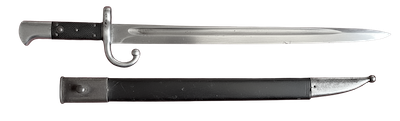
The first was a quadrilateral cross-sectioned socket bayonet, the simplest and most economical design, a hollow socket that fitted over the muzzle of the barrel and locked in place with a ring and spring catch. It was a purely functional thrusting weapon, intended to transform the rifle into a spear, with no secondary utility as a cutting tool. The second type was a yatağan-style sword bayonet, so called because its forward-curving blade echoed the profile of the traditional Ottoman yataghan knife. This was a considerably more capable weapon than the socket bayonet; with a blade varying between 60 and 80 centimeters, it could serve as a sidearm as well as a bayonet, and its curved single edge made it effective as a slashing weapon in close combat. The third type was a shortened and straightened version of the same yatağan bayonet, reflecting the general trend across all the major armies of the late nineteenth century toward shorter, more practical blades that were easier to manufacture and handle in the confined conditions of modern warfare. Peabody-Martini rifles with these bayonets remained in service with secondary and rear-area units until approximately 1916 or 1917, long after the weapon had been superseded in frontline formations by the Mauser.
The Long-Bladed Mauser Sword Bayonets: M1887 and M1890
The introduction of the Mauser rifle family brought with it a new generation of sword bayonets, all manufactured in Germany at the cutlery and metalworking centers of Solingen and Suhl. The bayonet issued with the M1887 Mauser was a long sword bayonet produced by the firm of Alexander Coppel and Company of Solingen, one of the leading German manufacturers of military edged weapons. It had a single-edged straight blade with a fullered groove running along its length to reduce weight while maintaining rigidity, tapering to a broad rounded spear point. The crossguard was distinctive: its lower section swept forward into a gracefully curved hook quillon ending in a ball finial, while its upper section formed a full muzzle ring to locate the bayonet on the barrel. The grip consisted of two wooden scales retained by steel rivets with circular washers. The scabbard was of black leather, slightly tapered and stitched along its length.
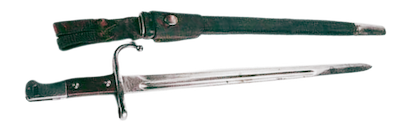
The M1890 bayonet followed a very similar pattern: long-bladed, sword-type, with wooden grips, a prominent hook quillon crossguard terminating in a ball finial, and a full muzzle ring. The crossguard of the M1890 was stamped with the weapon's serial number in Turkish Arabic script. The blade had a characteristic fuller and came to the same broad spear-point profile as the M1887 type. Examples survive in the collections of the Australian War Memorial, recovered from Ottoman positions in Egypt, Palestine, and Gallipoli. An M1890 bayonet in original unaltered condition measured approximately 22 and seven-eighths inches in overall length, with an 18-inch fullered blade. Most of these long bayonets were subsequently shortened in the 1920s to blades of around 10 inches, in line with the shorter patterns coming into general use worldwide, but wartime examples retain their original full-length blades.
The M1903 Bayonet: Two Patterns
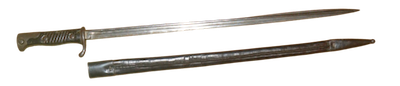
When the Ottoman government ordered the M1903 Mauser rifle, two distinct bayonet patterns were delivered alongside it. The first was a long quillback bayonet closely modeled on the German Seitengewehr 98, the standard bayonet for the Gewehr 98, featuring a narrow blade with a pipe back and a fuller running along its length, tapering to a swell point with a slight flare approximately 220 millimeters from the tip. Its crossguard had a long swept-forward hook quillon with ball finial and a very high full muzzle ring. Like the German original, it had a beaked pommel housing a T-shaped attachment slot, with a press stud on the right side operating a locking catch through an internal coiled spring. The grip was of two-piece wood retained by rivets. The scabbard was of black leather tapering to a point. This long pattern was seen relatively rarely in wartime photographs, likely because, as with its German counterpart, the long narrow blade had a tendency to snap under the lateral stresses of trench combat.
The second M1903 bayonet pattern was a shorter, wider-bladed type more closely resembling the S84/98 pattern, better suited to the conditions of close-quarters fighting. This shorter version was more commonly seen on M1903 rifles in wartime images. The M1903 rifle had been specifically designed to accept older Ottoman M1890 bayonets as well, providing useful interchangeability in the field.
The bayonets were marked on their blades with the crescent and star of the Ottoman state, and many bore the markings of the Ottoman military factory, indicating that some degree of local production or reworking took place alongside the German-supplied originals.
Bayonets in Combat
The bayonet was not merely a last resort in the Ottoman Army; it was a weapon that Ottoman soldiers were known to use aggressively and to considerable effect in the close-quarters fighting that characterized the Gallipoli campaign above all. When the 57th Infantry Regiment received Mustafa Kemal's famous order on 25 April 1915, out of ammunition and with nothing but bayonets to meet the Anzac advance up the slopes toward Conkbayırı (Chunuk Bair), the regiment charged and was destroyed to the last man, buying the time for reinforcements to arrive. It was one of the most celebrated acts of the entire campaign and it was executed with the bayonet.
At the Battle of Lone Pine in August 1915, when Australian forces broke into the roofed Ottoman trench system, the fighting descended within minutes into combat so close that rifles could barely be aimed. Men fought with bayonets, knives, clubbed rifle butts, and fists in the darkness of covered trenches where there was no room to swing a weapon or reload. The battle raged for four days in a labyrinth of underground passages, with Australian and Ottoman soldiers sometimes separated by only a few feet of packed earth. It was this kind of fighting, repeated with variations across the Caucasus and in the Arab provinces, that gave the bayonet its continuing relevance in a war nominally dominated by artillery and machine guns.
The Officer's Sword: From Kılıç to Modern Sabre
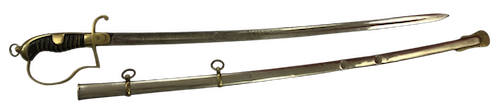
Ottoman officers carried swords throughout the First World War, a practice common to the officer corps of virtually every major army of the period. The Ottoman sword tradition was ancient and rich. The kılıç, the curved cavalry sabre associated above all with the Ottoman military, had been the dominant sword type of the empire for centuries. Characterized by a long blade curving slightly from the hilt and more sharply in the distal half, terminating in a widened and sharpened back-edge section called the yalman, the kılıç had served Ottoman cavalry in campaigns across three continents. By the late nineteenth century, however, the kılıç and its relatives had been officially withdrawn from military service as the practical utility of the sword declined with the spread of accurate repeating firearms. Cavalry units continued to carry curved sabres, but the weapon was by 1914 increasingly ceremonial in character, a mark of rank and martial identity rather than a primary instrument of war.
The pala, a shortened and heavier variant of the kılıç with a more pronounced curve, had been associated with Ottoman naval troops and urban militia forces, and examples remained in private ownership among officers. The karabela, a curved sword with a distinctive eagle-head or hooked pommel, was another type encountered in late Ottoman military use, though by 1914 primarily as an heirloom or ceremonial piece.
For the formal dress occasions, parades, and the daily wearing expected of officers on and off duty, the sword of the late Ottoman period was typically a western-influenced straight or slightly curved sabre in the European military style, reflecting the decades of military reform and Westernization that the army had undergone since the Tanzimat reforms of the mid-nineteenth century. German military influence, which had been profound since the mission of von der Goltz Pasha in the 1880s and had deepened through the Liman von Sanders mission of 1913, extended to military dress and ceremonial practice as well as to tactics and organization.
Daggers
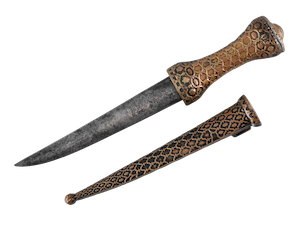
Daggers occupied a cultural as well as a practical place in Ottoman military life. The traditional Turkish dagger, typically 35 to 40 centimeters in length with a double-edged steel blade and a hilt of bone, ivory, silver, or gold-plated metal, had been carried by fighting men across the empire for centuries. Blades were frequently decorated with gold or silver inlay, floral motifs, Quranic inscriptions, or the Seal of Solomon, and the dagger's scabbard was often as elaborately ornamented as the weapon itself. For officers and senior figures, a fine dagger was an emblem of status as much as an instrument of violence. For infantrymen and irregular fighters in the field, it was a practical backup weapon for the moments, increasingly common in the close-quarters fighting of the First World War, when a rifle could not be brought to bear.
The Yatağan: The Inherited Blade
The yatağan was the most distinctively Ottoman bladed weapon and one of the most recognizable edged weapons in the world. Used since the mid-sixteenth century, it had been the signature weapon of the Janissary corps and had served as infantry short sword, naval boarding weapon, and everyday utility knife across the Ottoman domains. Its defining characteristic was its forward-curved single-edged blade, typically between 60 and 80 centimeters in length, with the cutting edge on the concave face and the spine on the convex. The blade was often forged from Damascus steel. The hilt was made without a guard, relying instead on two prominent ear-shaped pommel lobes, which gave the weapon its Turkish popular name kulaklı, meaning "eared", typically made of bone, ivory, or horn, sometimes sheathed in silver or decorated with coral and filigree work. The gap between the grip plaques was covered by a metal strap, frequently inscribed with Quranic verses or the owner's name.
By the time of the First World War, the yatağan had long since passed out of formal military service but had not disappeared. It survived as a personal knife or heirloom among older soldiers, irregular fighters, and tribal auxiliaries who still carried bladed weapons of cultural significance. It also survived indirectly in the design of the yatağan-style sword bayonets issued with the Peabody-Martini, whose forward-curved profile deliberately echoed the traditional Ottoman blade shape, reflecting the army's attempt to give its bayonet a form familiar to soldiers from the empire's diverse regions.
Artillery
- Ottoman artillery was largely supplied by Germany and centered on Krupp field and mountain guns, but the army possessed far fewer modern guns and howitzers than were needed for a multi-front war.
- The Balkan Wars severely weakened the Ottoman artillery arm, resulting in the loss of large numbers of guns and leaving insufficient time or resources to replace them before 1914.
- Ammunition shortages plagued Ottoman artillery throughout the war, particularly at Gallipoli and on the Caucasus Front, where limited shell supplies often restricted the effectiveness of gun batteries.
- German and Austro-Hungarian deliveries helped strengthen Ottoman artillery during the war, and despite shortages, Ottoman gunners performed effectively in defensive battles, especially during the successful defense of the Dardanelles.
Artillery was the most technically demanding and logistically complex dimension of Ottoman military power, and it was the area in which the gap between the army's needs and its actual capabilities was most acutely felt. The guns the Ottoman Army brought to the First World War were almost entirely foreign in origin, overwhelmingly German in design, and deeply insufficient in number given the scale of the conflict and the diversity of the fronts on which Ottoman forces would have to fight.
The Pre-War Arsenal and Its Composition
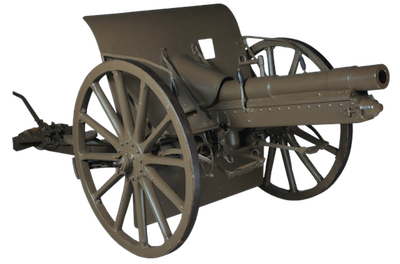
The dominant supplier of Ottoman artillery throughout the late nineteenth and early twentieth centuries was the German industrial giant Krupp, based in Essen. The relationship between the Ottoman Army and Krupp stretched back decades, and by 1914 the great majority of serviceable Ottoman field guns bore the Krupp name on their breeches. The most important pre-war purchase was the 75 mm Krupp M1903 field gun, designated the Feldkanone L/30, of which 648 were ordered. It had a maximum range of 6,000 meters, and 648 were purchased from Germany in the period before the First World War, although many were lost in the Balkan Wars. By the time war broke out in 1914, only 344 of the original order remained in Ottoman hands, the rest having been abandoned or destroyed during the catastrophic retreats of 1912 and 1913. In addition to this primary field gun, the army also operated smaller numbers of the older 87 mm Krupp Feldkanone L/24 M1885, which served as a stopgap in understrength batteries that could not be fully equipped with the modern M1903.
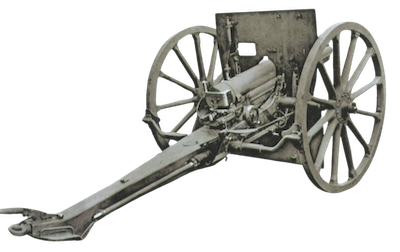
Alongside the Krupp guns, the Ottoman Army had acquired a small number of French Schneider 75 mm field guns. Around 52 Schneider 75 mm L/31 M1912 field guns were present in the Ottoman inventory, a confiscated batch originally ordered by Serbia from France. These guns were broadly comparable in performance to the Krupp M1903 but their French origin created distinct spare-parts and ammunition supply complications, since France was now an enemy power. The presence of Schneider guns in Ottoman service was less a product of policy than of opportunistic acquisition, and their maintenance during the war became increasingly difficult as access to French technical support was obviously impossible.
For mountain operations, the army relied principally on the 75 mm Krupp mountain gun, the Gebirgskanone L/14 M1904, a lighter weapon designed to be broken down into loads carried by mules and reassembled at the battery position. According to the divisional establishment set after the Balkan Wars, each divisional field artillery regiment was intended to have one battalion equipped with eight 75 mm Krupp Feldkanone L/30 M1903 field guns and another equipped with eight 75 mm Krupp Gebirgskanone L/14 M1904 mountain guns. Nevertheless, there were not enough guns to equip batteries even according to this lean establishment. The mountain gun was indispensable in the Caucasus, where the Allahüekber and Pontic mountain ranges made wheeled field artillery almost impossible to move during winter operations, and in Palestine, where the broken terrain of Sinai and the Judean Hills similarly favored lighter, dismountable weapons.
For heavier support, the army possessed a limited inventory of howitzers, including the 10.5 cm Krupp field howitzer and the 15 cm Krupp heavy howitzer, the latter a formidable weapon firing a 40 kg shell to a maximum range of over 10 kilometers. However, a general lack of howitzers and heavy artillery kept these formations weak. Howitzer and heavy artillery units were not assigned at divisional level but pooled at corps and army level, meaning that individual divisions often fought without any heavy fire support at all.
Force Distribution at the Outbreak of War
When the Ottoman Empire entered the war in November 1914, its artillery was distributed across four field armies. The First Army, stationed in Thrace and responsible for the defense of Istanbul and the Dardanelles Straits, was the best equipped: it had 95 batteries encompassing 61 field, 25 mountain, 3 howitzer, 2 heavy howitzer, and 4 cavalry types, for a total of 380 guns. The Second Army fielded 35 batteries, divided between 19 field and 16 mountain, with 140 guns. The Third Army, in eastern Anatolia facing Russia on the Caucasus Front, had 51 batteries: 17 field, 28 mountain, 5 cavalry, and 1 howitzer, for 204 guns. The Fourth Army, responsible for Syria and Palestine, had 33 batteries of 10 field and 23 mountain types, with 132 guns. Mobile army units in the field accounted for a further 856 guns, while the fortress artillery of the fixed defensive zones at Çatalca, Çanakkale, the Bosphorus, Edirne, and Erzurum added 912 more. The combined total at the outset of war was approximately 2,155 guns, with an average of just 588 rounds available per gun.
That average figure concealed wide variation. The well-stocked fortress positions at Çanakkale, which would have to repel the Allied naval assault in 1915, were among the better-supplied; the field armies in Anatolia and the Arab provinces were often drastically below even the modest standard implied by the army-wide average. Each Ottoman infantry division was supposed to be supported by six batteries of field guns, but in reality they had to make do with three or four at most.
Ammunition Shortages
Ammunition supply was a chronic and in some cases critical problem throughout the war. The 7.5 cm rapid-firing field guns consumed shells at a rate that peacetime procurement had never anticipated: as early as 1908, an emergency order of 167,000 shrapnel rounds had been placed with Erhart in Germany simply to bring the stockpile to a minimally acceptable level. Once multi-front warfare began, the situation deteriorated sharply. The Ottomans suffered from significant shortages of artillery shells throughout major campaigns. At Gallipoli, Ottoman gunners were frequently restricted in the number of rounds they could fire per day, forced to conserve shells even during major Allied assaults. The opening of a supply route through Bulgaria after that country joined the Central Powers in September 1915 provided some relief, but by the time much-needed German artillery ammunition arrived in November 1915, the Entente command had already decided to abandon Gallipoli.
On the Caucasus Front the ammunition situation was compounded by the near-impossibility of supplying a mountain theater in winter. At the Battle of Sarıkamış in December 1914 and January 1915, the Ottoman Third Army attempted an ambitious encircling offensive in snowbound mountain terrain with supply lines that were barely functional. By the climax of the battle, the IX Corps could muster not more than 6,000 men and fewer than twenty guns, facing a Russian force of about 14,000 men dug in with reinforced contingents of artillery and machine guns. The disparity in artillery support was one of several factors that contributed to the catastrophic Ottoman defeat, in which losses of between 78,000 and 90,000 men were sustained.
The Balkan Wars and Their Legacy
The Balkan Wars of 1912 and 1913 had already gutted the Ottoman artillery inventory before the World War even began. As the army retreated from its European provinces under pressure from Bulgaria, Greece, Serbia, and Montenegro, it was forced to abandon guns in the fortified cities that fell to the advancing Balkan coalitions. The loss of Ioannina, Salonica, Shkodër, and above all Edirne resulted in the abandonment of at least 44 Krupp 7.5 cm rapid-firing field guns, 18 Krupp 15 cm heavy howitzers, and 18 Krupp 10.5 cm field guns, along with older weapons too numerous to catalogue. These were irreplaceable losses. The interval between the end of the Balkan Wars in May 1913 and the outbreak of the World War in August 1914 was barely fifteen months, far too short to make good the deficit through new procurement even had the financial resources been available, which they largely were not.
Allied Supply and Wartime Deliveries
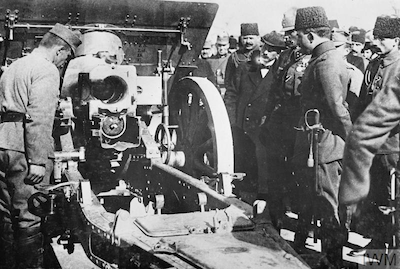
The Ottoman Army's artillery dependency on its German ally deepened dramatically once the war was underway. After 1916, Germany supplied the Turks with both types of the standard German Army field gun: the 77 mm Krupp M96 L/27 nA with a range of 7,800 meters, and the more modern 77 mm Rheinmetall M16 L/35 with a range of 9,000 meters. These were significant weapons, superior in range to the pre-war Krupp M1903 field gun, and their arrival helped offset the accumulated losses of the Balkan Wars and the early campaigns. German deliveries over the entire course of the war amounted to 559 artillery pieces in total, spanning field guns, mountain guns, and howitzers of various calibers, along with 500,000 artillery cartridges and 200,000 shrapnel shells.
Austria-Hungary contributed through the supply of Škoda mountain artillery, including the 75 mm Škoda M15 mountain gun, a modern and well-regarded weapon capable of a rate of fire of six to eight rounds per minute and an effective range of over 8,000 meters, and the older 70 mm Škoda mountain gun. In total, Austrian wartime deliveries included 144 Škoda 75 mm M15 mountain guns, 20 Škoda 70 mm M99 mountain guns, 40 Skoda 105 mm M16 mountain howitzers, and 12 Škoda 150 mm M14 field howitzers. The Škoda mountain guns in particular were well suited to the Ottoman fronts, where the majority of active fighting took place in terrain that severely restricted the movement of heavier wheeled equipment. Captured Russian and British guns also entered Ottoman service as battlefield trophies, adding yet further diversity to an already heterogeneous inventory.
Artillery in Practice
Despite its quantitative and qualitative deficiencies, Ottoman artillery performed with considerable effectiveness in specific contexts, above all in the defense of prepared positions. At Gallipoli, Ottoman gunners used their knowledge of the terrain and the advantages of elevation to direct plunging fire onto Allied beachheads and trench lines in ways that fixed artillery on flat ground could not replicate. Thanks to a solid educational and training background, modern unit structure, Balkan Wars experience, and absorbed German military doctrine, the Ottoman artillery functioned better than many Allied observers had expected during the Gallipoli campaign. The fortress artillery at Çanakkale, a mix of modern Krupp guns and older naval pieces mounted in fixed emplacements, had already repelled the Allied naval assault in March 1915, contributing to the decision to attempt a land invasion. In the defense of the Straits, Ottoman gunners demonstrated that even an underfunded and underequipped artillery arm could achieve decisive results when terrain and fortification compensated for numerical inferiority.
Machine Guns
- The Ottoman Army entered the First World War with a serious shortage of machine guns, despite lessons from the Balkan Wars demonstrating their importance on the modern battlefield.
- The main machine gun in Ottoman service was the German-made MG09, while additional MG08 Maxim guns were supplied by Germany and Schwarzlose guns by Austria-Hungary during the war.
- The use of multiple machine gun types and calibers created significant logistical challenges, as each required different ammunition, spare parts, and maintenance procedures.
- Although Ottoman doctrine called for machine gun companies in every infantry regiment, shortages meant many units lacked their full complement of weapons, forcing troops at battles such as Gallipoli to rely heavily on rifles and defensive terrain.
Of all the Ottoman Army's material deficiencies at the outbreak of the First World War, the shortage of machine guns was the most tactically consequential. The wars of the preceding decade had demonstrated beyond any reasonable doubt that the machine gun had become the dominant weapon of the modern battlefield: it could pin down advancing infantry, hold prepared positions against repeated assault, and substitute, to a degree, for numerical inferiority in manpower. The Ottoman Army understood this in principle but had been unable to act on it in time. When the war began, the army entered combat with a chronic and in some theaters critical scarcity of automatic weapons that it would never fully overcome.
From Coastal Defense to Infantry Weapon
During the first decade of the twentieth century, the Ottoman Army had virtually no dedicated infantry machine gun units at all. The few automatic weapons in the army's possession were assigned entirely to warships and coastal defense installations, not to field formations. These were all of the Maxim-Nordenfeld type, a hybrid weapon produced under license that combined elements of Hiram Maxim's recoil-operated mechanism with Nordenfeld's feed system, and their numbers were negligible. The conceptual step from fixed coastal emplacement to mobile infantry weapon had not yet been made in Ottoman military doctrine, and the financial resources to equip and train infantry machine gun companies did not exist.
The Balkan Wars of 1912 and 1913 were a brutal education. Facing Bulgarian, Serbian, and Greek forces that made aggressive use of machine guns in both attack and defense, Ottoman infantry suffered heavily in engagements where their opponents could concentrate automatic fire across open ground. The experience forced a reassessment of doctrine and procurement, but the interval between the end of the Balkan Wars in May 1913 and the outbreak of the World War in August 1914 was too short, and the financial and logistical situation too precarious, for the army to make good the deficit. Many of the machine guns it did possess had already been lost in the retreats of 1912 and 1913, abandoned in the fortified cities that fell to the Balkan coalition.
The MG09: The Standard Pre-War Weapon
The principal machine gun in Ottoman service at the start of the war was the Maxim Model 1909, designated the MG09, a weapon developed and produced by Deutsche Waffen und Munitionsfabriken (DWM) in Germany. The MG09 was a commercial export version of the German Army's own MG08, specifically adapted for overseas sale. Whereas the MG08 was chambered for the standard German 7.92 mm cartridge and mounted on a distinctive flat sled-type mount, the MG09 was produced in 7.65 mm caliber to match the standard Ottoman Mauser rifle ammunition, and it was mounted on a conventional tripod rather than the sled, giving it a slightly different silhouette that made the two models easy to distinguish. The MG09 was also somewhat lighter than the MG08, with a simplified muzzle booster, and it carried the Sultan's tughra — the royal monogram — engraved on the top of its water jacket, an indication that these were purpose-ordered weapons rather than surplus transfers. The gun was water-cooled, recoil-operated, and fed by a fabric belt. Its effective range was approximately 2,000 meters and its rate of fire was around 300 to 400 rounds per minute.
The MG09 was the weapon that Allied troops at Gallipoli encountered in 1915. Two examples captured by the 3rd Battalion of the Australian Imperial Force during the assault on Lone Pine on 6 August 1915 are preserved at the Australian War Memorial in Canberra, tangible evidence of these weapons in frontline Ottoman service. However, many MG09s had already been lost in the Balkan Wars, and the total number in Ottoman hands in 1914 was far below what an army fighting on multiple fronts required.
The MG08 and Wartime German Supply
The principal route by which the Ottoman machine gun inventory was expanded during the war was German military aid, but this supply was severely disrupted during the most critical period of the conflict. When the war began in 1914, direct land links between Germany and the Ottoman Empire were blocked: Serbia, Romania, and Bulgaria lay between them, and none of these countries initially permitted the transit of German war material. The Entente naval blockade in the Mediterranean further restricted maritime supply. The Ottoman Army was effectively cut off from its German supplier at precisely the moment when demand for modern weapons was greatest.
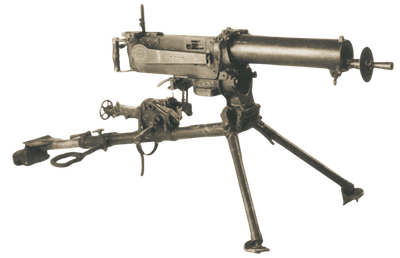
The situation changed only after Bulgaria entered the war on the side of the Central Powers in September 1915, opening a continuous overland corridor from Germany through Bulgaria to Ottoman territory. The Germans began supplying the Ottoman Army with the MG08, the standard heavy machine gun of the German Army, once these direct transport links were re-established. The MG08 was chambered in 7.92 mm rather than the 7.65 mm caliber of the MG09, which meant that it required a separate ammunition supply, adding yet another logistics complication to an already strained system. It was fed by a 250-round fabric belt, weighed approximately 26 kg on its sled mount, and was capable of a sustained rate of fire of up to 400 rounds per minute. Later in the war, the lighter MG08/15, a modified version with a bipod intended for use by assault troops, also entered Ottoman service. By the time significant quantities of MG08s arrived, however, the fighting at Gallipoli was over. Both the MG09 and the MG08 were used by Ottoman forces in the subsequent Sinai and Palestine campaigns.
Over the entire course of the war, Germany supplied a total of 1,570 light machine guns and 30 heavy machine guns to the Ottoman Army, a contribution that was significant in absolute terms but insufficient given the scale of operations and the attrition of combat.
The Schwarzlose: The Austrian Contribution
Alongside the German Maxim variants, the Ottoman Army also operated the Schwarzlose M.07/12, the standard heavy machine gun of the Austro-Hungarian Army and one of the more unusual designs in use during the war. Where the Maxim-derived weapons used a short-recoil mechanism, the Schwarzlose employed a delayed blowback action — the only heavy machine gun of the war to succeed using this simpler operating principle. It was designed by Berlin-based engineer Andreas Wilhelm Schwarzlose, patented in 1902, and produced from 1907 by Steyr in Austria. During the war, Austria-Hungary exported the M.07/12 to its Ottoman and Bulgarian allies.
The Schwarzlose was water-cooled and belt-fed, typically with a 250-round cloth ammunition belt. Its combined weight of gun and tripod was approximately 41.4 kg. The initial M.07 variant had a cyclic rate of around 400 rounds per minute, later increased to 580 rounds per minute in the improved M.07/12 by fitting a stronger spring. It was chambered in the Austro-Hungarian 8 x 50 mm Mannlicher cartridge, which was yet another caliber distinct from both the Ottoman Mauser round and the German 7.92 mm, further complicating the ammunition supply picture for a force already struggling with logistical diversity. Its short barrel contributed to a distinctive muzzle flash that could temporarily blind the gunner in darkness, a problem addressed by the fitting of a cone-shaped flash suppressor. The Schwarzlose was a robust and reliable weapon in static defensive positions, but its unusual operating mechanism made it less adaptable than the Maxim to field improvisation and alternate mounting arrangements, and its reliability declined under the extreme cold conditions of the Caucasus front.
The Hotchkiss
A small number of Hotchkiss machine guns also appeared in Ottoman service. The Hotchkiss was a French-designed gas-operated weapon, air-cooled rather than water-cooled, and fed by rigid metal strips rather than fabric belts. The strip feed was the Hotchkiss design's most distinctive feature and its principal tactical limitation: each strip held only 24 or 30 rounds, meaning that sustained fire required a steady and rapid supply of loaded strips, placing a higher burden on the gun crew than the belt-fed Maxim or Schwarzlose. The Hotchkiss guns in Ottoman hands were almost certainly legacy purchases from before the war, acquired during a period when the army was sourcing weapons from multiple European manufacturers without a unified procurement strategy. Once France became an enemy power in November 1914, any possibility of obtaining Hotchkiss spare parts, replacement barrels, or ammunition strips through normal commercial channels ended entirely.
Tactical Organization and the Gap Between Theory and Practice
By the eve of the war, Ottoman doctrine called for each infantry regiment to include a dedicated machine gun company equipped with four Maxim guns. The regiment comprised three infantry battalions, none of which had organic machine gun assets of their own; all automatic fire support was concentrated at regimental level in the machine gun company. This organizational model was already considered conservative by European standards, where armies were moving toward lower-level machine gun distribution, but it was in any case an aspiration that the shortage of weapons made difficult to achieve in practice.
The realities at Gallipoli illustrated the gap starkly. The 9th Ottoman Division, responsible for defending the southern Gallipoli peninsula when Allied forces landed on 25 April 1915, had only two of its three regiments equipped with machine gun companies, owing to the severe shortage of weapons. There were no machine guns assigned at battalion level. When the Anzac landing took place at what is now Anzac Cove, the defenders in that sector had to rely on rifle fire alone in the initial hours, until reserves with machine guns could be moved forward. The fact that the Ottomans nonetheless managed to hold their positions, and ultimately to prevail at Gallipoli, reflected the exceptional defensive qualities of the terrain and the quality of Ottoman infantry, rather than any adequacy in automatic weapons.
Sidearms and Pistols
- Ottoman officers carried a highly diverse range of pistols in the First World War, with no standard-issue sidearm; weapons were often privately purchased, inherited, or issued in limited quantities.
- Older revolvers like the Smith & Wesson No. 3 remained in use alongside early semi-automatic pistols, reflecting the transition from 19th-century to modern handgun technology.
- Semi-automatic pistols such as the Mauser C96, FN Browning M1903, Luger P08, and Steyr M1912 were used by officers, each representing different national suppliers and operating systems.
- This variety created severe logistical fragmentation, with multiple incompatible calibers and designs, mirroring the broader Ottoman problem of non-standardized weapon procurement.
The pistol occupied a specific place in Ottoman military culture: it was above all an officer's weapon, a mark of rank carried at all times as both a practical sidearm and a symbol of authority. Unlike the rifle, which was a soldier's tool, the pistol was personal, often privately purchased, and chosen to some degree by individual preference and availability. The result was a sidearm inventory that was even more diverse than the army's rifle arsenal, spanning weapons from several countries, several decades, and at least four different operating systems. There was no single standardized officer's pistol in the Ottoman Army during the First World War. What existed instead was a collection of models, some issued through official procurement, others bought privately, and others still inherited from an earlier era, that reflected the empire's historical trajectory and its dependence on foreign suppliers.
The Smith and Wesson No. 3: The Revolver Legacy
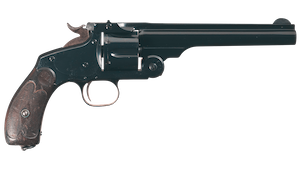
Before the age of semi-automatic pistols, the standard officer's sidearm in the Ottoman Army had been the Smith and Wesson No. 3 revolver, and examples of this weapon remained in service well into the First World War. The Ottoman relationship with the No. 3 was long and distinctive. Beginning in 1874 and continuing until 1883, the Ottomans placed a series of orders with Smith and Wesson for the No. 3 in .44 Henry Rimfire caliber, a configuration produced for no other customer. The reason was practical: the Ottoman Army had substantial stocks of the 1866 Henry repeating rifle chambered for the same .44 Henry Rimfire cartridge, and standardizing the revolver to the same ammunition simplified supply. The orders included 2nd and 3rd Model Russian No. 3 variants as well as the New Model No. 3, totaling several thousand pieces across nearly a decade of procurement. The No. 3 was a top-break revolver, meaning the barrel and cylinder tilted forward on a hinge to eject spent cases simultaneously, a faster reloading system than the side-gate designs used on contemporary American revolvers. By the time the First World War began, the S&W No. 3 was technically obsolete, its single-action mechanism and rimfire cartridge belonging to another era of firearms design. Nevertheless, it remained present in Ottoman inventories, particularly among older officers and rear-echelon troops for whom a modern semi-automatic pistol had not been issued.
The Mauser C96: The Palace Guard Pistol
The Ottoman Empire holds a notable place in the history of the Mauser C96, as it was the recipient of Mauser's very first military contract for that weapon. The C96 had been introduced in 1896 as one of the earliest practical semi-automatic pistols in the world, recognizable by its distinctive silhouette: a long barrel fixed to the frame, an integral box magazine positioned forward of the trigger, and a rounded wooden grip that gave the weapon its most famous nickname in English-speaking countries, the "broom handle." The original version used a stepped conical hammer, which gave rise to a second nickname: the "cone hammer." It was chambered for the 7.63 x 25 mm Mauser cartridge, at the time the highest-velocity commercially produced pistol ammunition in the world, giving it exceptional range and penetration for a handgun.
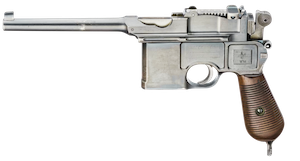
Sultan Abdülhamit II signed the contract in December 1897 and the guns were shipped in May 1898: 1,000 cone-hammer C96 pistols, numbered in Farsi in their own serial range from 1 to 1000, each sold with a matching detachable shoulder stock that converted the pistol into a short carbine. The guns were purchased for the royal palace guard rather than for the regular army, and here a significant detail emerges about the politics of the late Hamidian period: the Sultan, deeply anxious about the possibility of a military coup, kept much of the army's modern weaponry locked in armories rather than distributed to troops. Many of the C96 pistols shared this fate, stored rather than issued. Nevertheless, the C96 appeared in Ottoman officer hands throughout the war, whether through official channels or private purchase, and it was sufficiently associated with Turkish officers in Allied eyes to appear as a standard prop in popular representations of the conflict.
The C96's practical strengths were considerable. Its 10-round integral magazine, loaded by pressing a stripper clip downward through the open action, gave it greater capacity than most contemporary pistols. Its long barrel produced a muzzle velocity significantly higher than shorter-barreled competitors. The optional shoulder stock transformed it into a weapon of genuine accuracy at distances well beyond the normal pistol range. Its weaknesses were equally significant: it was expensive and complex to manufacture, its integral magazine was slower to reload than a detachable box, and its unconventional ergonomics were considered awkward by many users. No major European military adopted it as a standard issue weapon, but for officers who could afford to purchase one privately, it had real appeal.
The FN Browning M1903: The Most Widespread Sidearm
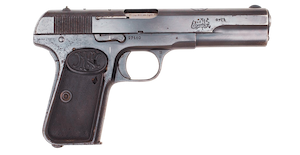
The pistol with the widest distribution among Ottoman officers was in all likelihood the FN Browning M1903, a semi-automatic pistol designed by the American inventor John Moses Browning and manufactured in Belgium by Fabrique Nationale. It was this weapon, rather than the C96, that formed the practical backbone of Ottoman officer sidearm inventory during the war. Chambered for the 9 x 20 mm Browning Long cartridge and fed by a seven-round detachable box magazine, the M1903 was 205 mm in overall length and weighed 930 grams unloaded. Its grip panels were made of black plastic. A rear grip safety catch, which had to be depressed by the hand holding the pistol before the weapon would fire, was a notable safety feature. The M1903 operated on a simple blowback principle and was appreciated for its reliability, accuracy, and ease of handling. A total of approximately 153,000 were manufactured between 1903 and 1914, making it one of the most widely produced semi-automatic pistols of the pre-war era. It was also used by Russian officers, a detail that could in theory create battlefield confusion, though in practice the caliber and profile of the weapon were sufficiently distinct from Russian service revolvers to minimize the risk. Earlier Browning models from the same manufacturer, particularly the FN M1900 chambered for .32 ACP, were also present in smaller numbers among Ottoman officers who had purchased them commercially in the years before the war.
The Luger P08: The German Alliance Connection
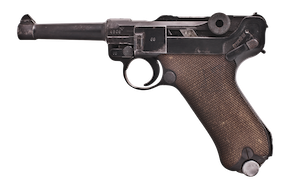
The Luger Parabellum, officially designated the Pistole 08, was the standard sidearm of the German Army and appeared in Ottoman hands through the close alliance between the two empires. The P08 was chambered for the 9 x 19 mm Parabellum cartridge, operated by a distinctive toggle-lock action that made it one of the most mechanically elegant pistols of its era, and was fed by an eight-round detachable box magazine. Its overall length was approximately 220 mm with the standard 100 mm barrel, and it weighed around 870 grams unloaded. German naval officers aboard the SMS Goeben and SMS Breslau, the two warships transferred to Ottoman service in August 1914 with their German crews aboard, brought their Navy Lugers with them; at least 100 of these weapons were thus present in Ottoman waters from the very opening of the empire's war. German officers attached to Ottoman formations throughout the war also carried the P08, and some quantities found their way into Ottoman officer hands through direct gift, purchase, or the normal exchanges that occur between allied armies in the field.
The Steyr M1912: The Austrian Contribution
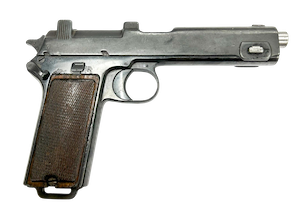
Through the Austro-Hungarian alliance, the Ottoman Army also encountered the Steyr M1912, known as the Steyr-Hahn, which was the standard service pistol of the Austro-Hungarian Army. Designed between 1909 and 1910 and produced by Österreichische Waffenfabriksgesellschaft in Steyr, it was chambered for the 9 x 23 mm Steyr cartridge, a proprietary round distinct from the German 9 mm Parabellum, and was fed by an eight-round integral magazine loaded from stripper clips in a manner similar to a rifle. It was 216 mm in length, weighed 1.2 kg, and operated on a short-recoil locked-breech mechanism that made it robust and reliable in field conditions. The Austrian M.12 pistols mentioned in contemporary accounts of Ottoman sidearms were almost certainly Steyr M1912 examples transferred through the alliance supply chain, used primarily by Ottoman officers who had direct logistical contact with Austro-Hungarian formations.
A Diverse and Improvised Arsenal
Taken together, the Ottoman officer corps went to war with a sidearm inventory that defied standardization. The Mauser C96 in 7.63 mm, the FN Browning M1903 in 9 mm Browning Long, the Luger P08 in 9 mm Parabellum, the Steyr M1912 in 9 mm Steyr, and the surviving S&W No. 3 revolvers in .44 Henry Rimfire; these were five different weapons requiring five different cartridges, sourced from four different countries, spanning a production history of more than four decades. No two were interchangeable in ammunition or spare parts. The situation was in miniature a reflection of the broader Ottoman weapons predicament, an army that had procured what it could, when it could, from whoever would sell to it, and that now had to fight a modern war with an arsenal assembled through necessity rather than design.
Grenades
- Grenades were a crucial Ottoman infantry weapon in World War I, especially at Gallipoli, where extremely close trench fighting made explosive short-range weapons more important than rifles.
- The main Ottoman grenade was the domestically produced Tüfekçiyef spherical grenade, which initially gave Ottoman troops an advantage over Allied forces that had to improvise early in the campaign.
- Later in the war, the Ottomans also used improved domestic designs like the Type 2 grenade, as well as German Stielhandgranate stick grenades supplied through the Central Powers alliance.
- Alongside factory-made weapons, improvised “corded bombs” were widely used, reflecting both supply shortages and the high demand for explosive devices in trench warfare conditions.
The hand grenade occupied a more central place in Ottoman infantry tactics during the First World War than in almost any other theater of the conflict, and this was above all because of Gallipoli. The nine-month campaign of 1915 on the peninsula produced conditions of extreme close-quarters fighting, in which trenches were sometimes only meters apart and the ability to throw an explosive into an enemy position was as important as accurate rifle fire. In this environment, the Ottoman Army held a significant early advantage: it entered the campaign with a manufactured and reasonably well-supplied grenade in its inventory, while the Allied forces had none and were forced to improvise. Understanding Ottoman grenade use during the war requires distinguishing between the domestically produced weapons that defined the Gallipoli campaign and the German-supplied weapons that arrived later.
The Tüfekçiyef Ball Grenade: The Primary Ottoman Weapon
The grenade most closely associated with Ottoman forces in the First World War was not a German import but a domestically designed and manufactured weapon: the Turkish 1914 model spherical grenade. The weapon was designed by an Ottoman officer of ethnic Bulgarian origin named Naum Tüfekçiyef, and it was manufactured at the several contract foundries in the Galata district of Istanbul, such as Kalafatyeri, Perşembe Pazarı, Pastırmacıyan Hanı and Halıcılar Hanı.
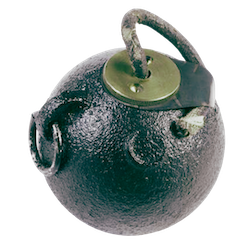
The grenade's construction was straightforward. Its spherical cast iron body had a diameter of approximately 73 mm, roughly the size of a cricket ball, which explained the nickname Anzac troops gave it. The outer surface of the body was divided into equal rectangles and dimpled on the inside to encourage fragmentation upon detonation. Each grenade was filled with 100 grams of TNT, and was equipped with a copper-tubed fuse containing two grams of fulminate of mercury as the initiating charge. Ignition was achieved by striking a matchhead against an abrasive igniter carried by the grenadier, in the same manner as lighting a safety match. The fuse was protected by a screwed bronze cap on the exterior.
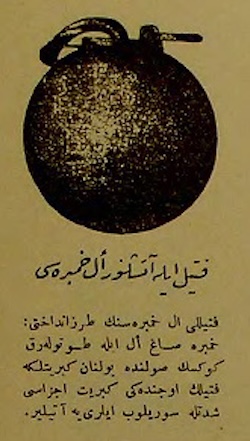
In its initial production version, the Tüfekçiyef had a ten-second fuse delay, which proved too long in trench warfare conditions. Allied troops, particularly Australians in Gallipoli, quickly discovered that a grenade with a ten-second delay could be caught and thrown back before it detonated. The Ottomans shortened the fuse delay to five seconds in response, reducing but not entirely eliminating the window for this dangerous countermeasure. Contemporary accounts from Allied soldiers describe the Tüfekçiyef as elegant in its simplicity and highly effective in trench fighting.
The tactical significance of this advantage was considerable. In the early weeks of the Gallipoli campaign, the Ottoman defenders had a seemingly abundant supply of these grenades, while the British and Anzac forces had none at all. Allied troops were reduced to improvising bombs from empty jam tins or bully beef cans packed with nails, scrap metal, and an explosive charge, wired together at improvised bomb factories on the beaches. These homemade weapons were unreliable, difficult to throw accurately, and significantly less effective than the manufactured Turkish grenade. Specially produced Allied grenades did not begin arriving on Gallipoli in meaningful numbers until August 1915, by which point the campaign was already many months old. The bombing exchanges at contested positions like Quinn's Post, Courtney's Post, and Lone Pine were shaped throughout by the Ottoman grenade's early superiority.
The Tüfekçiyef was not without weaknesses. Its cast iron body, while it fragmented reliably, tended to break into large irregular chunks rather than the smaller, more numerous fragments produced by grooved or segmented designs like the British Mills bomb. This reduced its effectiveness against troops in the open, though in the confined environment of a trench or dugout, large fragments were lethal enough.
The Type 2 Infantry Grenade: The Later Design
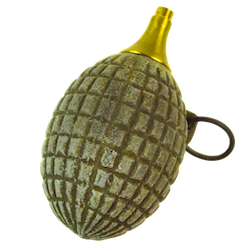
As the war progressed and the Ottoman Army gained exposure to Allied grenade designs, it developed a second domestic grenade type, known as the Type 2 Infantry Grenade. This weapon did not appear until approximately 1916, too late to play any role at Gallipoli. Its design was influenced by the British No. 5 Mills bomb, which had been introduced to the Dardanelles theater in late 1915 in small numbers, and which represented a significant step forward in grenade design: the segmented ovoid body, the central striker mechanism, and the fly-off safety lever were all features the Ottoman designers drew upon. The Type 2 was substantially larger than the Tüfekçiyef, measuring approximately 127 mm in length and 74 mm in width, and unusually for a grenade its body was cast from zinc rather than iron or steel, with a brass fuse housing. Its size and material made it considerably heavier than most contemporary grenades when filled. It was used primarily in the later campaigns in Palestine and Mesopotamia.
The German Stielhandgranate
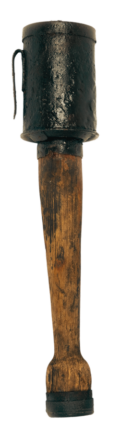
In addition to its domestically produced grenades, the Ottoman Army also received and used the German Stielhandgranate, the iconic stick grenade that became one of the most recognizable infantry weapons of the entire war. The Stielhandgranate consisted of an explosive charge housed in a thin sheet metal canister, attached to a hollow wooden handle that contained the friction ignition mechanism. To arm and throw the grenade, the soldier unscrewed a protective cap from the base of the handle, pulled a porcelain bead on the cord contained within the handle shaft to ignite the delay fuse, and threw the weapon. The design gave the thrower significantly more leverage than a spherical grenade, extending the achievable throwing distance to between 40 and 60 meters, compared to roughly 25 to 30 meters for a ball-shaped design of similar weight. This range advantage was particularly valuable in attack, where the ability to saturate an enemy trench from a greater distance reduced the attacker's exposure.
The first production version, the Stielhandgranate 15 (M15), weighed approximately 820 grams in total, with a 250-gram charge of ammonal explosive in the canister head, and had a fuse delay of 5.5 or 7 seconds. It had one significant design flaw: the pull cord that activated the igniter protruded from the base of the handle and could snag on equipment or debris, potentially triggering the fuse accidentally. This led to the introduction of the improved Model 1916 (M16), which housed the porcelain bead and cord inside a protective cap screwed to the handle's base, and introduced the improved Brennzünder 16 friction fuse with better moisture resistance. The M16 also refined the handle grip for better performance in the muddy and confined conditions of trench fighting. It was this second version that reached Ottoman hands in significant numbers as German alliance supply expanded during 1916 and 1917.
The Stielhandgranate was a weapon optimized for offensive use. Its design dispersed blast energy rather than producing wide fragmentation, making it most effective in enclosed spaces such as dugouts, bunkers, and the fighting bays of trenches, where the concussive effect at close range could incapacitate defenders without the risk of the thrower being hit by his own grenade's fragments. Its effectiveness in open terrain was considerably less, and for defensive use against troops in the open, a fragmentation grenade was generally preferable.
The Corded Bomb
Archaeological evidence recovered from the Gallipoli peninsula and surrounding areas has also documented a third category of Ottoman explosive, which is the corded bomb, a cylindrical or irregular improvised device bound with cord and fitted with a simple fuse. A construction site excavation near the Gallipoli peninsula in 2022 recovered 656 corded bombs alongside 70 conventional grenades from Ottoman positions, giving a sense of the scale at which these improvised weapons were produced and stockpiled. The corded bomb was not a precision weapon, rather it was a field-expedient device assembled from available materials when manufactured grenades were in short supply or when local commanders required additional munitions in a hurry. Its construction from cord-wrapped metal or ceramic containers filled with explosive and fitted with a burning fuse placed it closer in concept to the improvised bombs found on all sides of the conflict, but its presence in such large numbers alongside manufactured weapons suggests it played a genuine supplementary role in Ottoman grenade supply throughout the war.
Grenade Warfare in Context
The Ottoman Army's grenade inventory, taken as a whole, evolved substantially over the four years of the war. At Gallipoli in 1915, the Tüfekçiyef ball grenade was the army's primary close-quarters weapon, produced domestically, present in significant numbers, and tactically effective enough to give Ottoman defenders a meaningful advantage over Allied forces in the critical early months of the campaign. As the war continued and German alliance supply deepened, the Stielhandgranate provided a longer-range offensive complement. The Type 2 grenade, influenced by captured Allied designs, represented an attempt to develop a more sophisticated fragmentation weapon for the later campaigns. The corded bomb filled gaps where manufactured supply fell short.
Supply, Logistics, and Allied Assistance
- Ottoman military performance was fundamentally constrained by weak logistics, limited industrial capacity, and an underdeveloped transport network, making sustained modern warfare extremely difficult.
- At the start of the war, the Empire was effectively isolated from Germany due to naval blockade and blocked Balkan land routes, causing severe shortages of ammunition, artillery, and modern weapons.
- Even after the Balkan route opened in late 1915, the incomplete Baghdad Railway created major bottlenecks, forcing multi-stage transport across mountains by rail, mule, and wagon, which slowed and complicated supply lines.
- Large-scale German and Austro-Hungarian aid eventually supplied weapons, ammunition, and expertise, but these deliveries, though substantial, still fell short of what was required for a multi-front industrial war.
Of all the structural problems that constrained Ottoman military performance in the First World War, none was more fundamental or more persistent than logistics. The army was not merely dependent on foreign suppliers for its weapons; it lacked the industrial base, the transport infrastructure, and the financial reserves to sustain those weapons in the field once delivered. The logistical story of the Ottoman war effort is, at its core, a story of an agricultural empire attempting to fight a modern industrial war across four major fronts simultaneously, with a railway network that was unfinished, a domestic arms industry that was rudimentary, an alliance supply corridor that was severed for the most critical phase of the conflict, and an enemy blockade that closed the sea lanes from the first day of war.
The Domestic Industrial Base
The Ottoman Empire's capacity to produce weapons and military equipment domestically was severely limited throughout the war. The principal military manufacturing establishments were in Istanbul: the Zeytinburnu Iron Factory, which had operated under the Ministry of War since the mid-nineteenth century and produced rifle ammunition, artillery shells, shrapnel rounds, and some small arms; the Tophane Arsenal, which served as the empire's main armory and had some capacity for rifle repair and limited production of imitation Mauser rifles; and the Imperial Arsenal on the Golden Horn, which handled naval ordnance and general military stores. During the Abdülhamit II era, Zeytinburnu had been expanded to produce a range of war materiel including shafts, cannonballs, steel shrapnel, and cartridge cases, and the factory had even manufactured Turkey's first quick-firing field gun in the 1860s. By the time of the First World War, German technical advisers were brought in to assist with expanding and modernizing production, and the factory began producing imitation Mauser rifles alongside its ammunition output, with numbers growing to significant levels in the course of the war.
Despite these efforts, domestic production remained structurally insufficient. The Zeytinburnu plant could manufacture rifle cartridges but not in the volumes required by a multi-front war. It could repair and in limited quantities produce small arms, but it could not manufacture artillery pieces, machine guns, or the complex optical and mechanical components that modern weapons required. The empire had no capacity whatsoever to produce motor vehicles, aircraft, or the chemical weapons that were entering use on the Western Front. For all of these, it was entirely reliant on its allies. This was not a temporary wartime shortfall but a reflection of the empire's fundamental economic structure: it was, as contemporary observers noted, an agricultural state attempting to wage industrial warfare.
The Blockade and the Isolation from Germany
When the Ottoman Empire entered the war in November 1914, it found itself immediately isolated from its primary source of weapons and military equipment. The Entente powers imposed a naval blockade of the eastern Mediterranean, officially declared on 25 August 1915 but effectively operative from the outset of hostilities. British and French naval forces controlled the Aegean, the eastern Mediterranean, and the sea approaches to Istanbul, preventing any maritime resupply from Germany or Austria-Hungary. At the same time, the land route from Germany to the Ottoman Empire was blocked by the presence of hostile or neutral states in the Balkans. The railway from Germany to Istanbul passed through Serbia, Romania, and Bulgaria, none of which initially permitted the transit of German war material. Neutral Bulgaria and Greece effectively closed their borders to Central Powers supply traffic, and Serbia was actively fighting on the Entente side.
The result was that the Ottoman Army went to war in a state of near-complete logistical isolation from its most important ally, at precisely the moment when it needed weapons, ammunition, and equipment most urgently. The losses of the Balkan Wars had left the artillery inventory depleted and the machine gun supply critically thin. Stocks of artillery shells fell to dangerously low levels within months of the war's beginning. The Ottoman field armies were forced to fight their battles without the intensive artillery support that had become the standard operating method of the other great powers, compensating with the defensive use of terrain and the tenacity of their infantry.
This isolation lasted until Bulgaria entered the war on the side of the Central Powers in October 1915, and Serbian resistance collapsed under the combined Austro-Hungarian and Bulgarian offensive that autumn. With Serbia overrun, a continuous overland railway corridor from Germany through Austria-Hungary and Bulgaria to Ottoman territory was finally opened. German military supplies began flowing in significant quantities from late 1915 onward. The difference was immediate and measurable: it was the arrival of this supply corridor that enabled Germany to begin delivering the MG08 machine guns, the 77 mm field guns, the artillery ammunition, and the other weapons that the Ottoman fronts had been starved of for over a year.
The Railway Problem: Gaps, Bottlenecks, and the Cost of Incompleteness
Even when the external supply route from Germany was open, getting weapons and supplies from Istanbul to the armies in the field remained a formidable logistical challenge. The Ottoman railway network was one of the most underdeveloped of any major belligerent, and its central deficiency was the incompleteness of the Baghdad Railway, the grand German-financed project intended to link Istanbul to Baghdad through Anatolia and the Arab provinces.
At the outbreak of war, two critical gaps remained in the Baghdad Railway's route southward through Anatolia. In the Taurus Mountains, a 38-kilometer section remained unfinished, with the tunneling required to penetrate the mountain range still incomplete. In the Amanus Mountains further south, a 100-kilometer gap similarly interrupted the line. These were not minor inconveniences: they meant that any supplies moving from Istanbul toward Palestine, Mesopotamia, or the Caucasus had to be unloaded from standard-gauge railway cars at the northern edge of the Taurus, transported across the mountains by mule, wagon, or the few available motor vehicles, loaded onto a short section of narrow-gauge track running through a provisional tunnel at Belemedik, unloaded again at the southern end of the Taurus, reloaded onto standard-gauge cars for the stretch to the Amanus, and then unloaded, carried across the second mountain range, and reloaded a fourth time before continuing southward. A journey that might take seventeen hours by continuous rail could stretch to three or four days, or longer in winter. The Taurus crossing alone required climbing from sea level at Yenice to an altitude of 1,400 meters in just 108 kilometers, through 37 tunnels with a combined length of 14.4 kilometers and grades approaching 2.5 percent.
The consequence was that the entire logistical system supplying the southern fronts was throttled at these two mountain crossings. Artillery pieces, crated ammunition, machine guns, and all the other heavy equipment required for modern warfare had to be carried by pack animals over the same mountain paths that soldiers trudged on foot. The mule and the camel became, by necessity, as important to Ottoman military supply as the railway engine. After reaching Aleppo, supplies heading further south were transferred yet again from standard to narrow gauge for onward movement, and the final leg to troops in the field was completed by animal transport entirely.
Fuel for the railway engines themselves became a crisis as the war continued. Coal was the natural fuel for steam locomotives, but the Entente blockade cut off coal imports, and Ottoman domestic reserves were inadequate. An attempt to use coal from Mount Lebanon failed because the local coal contained too much sulfur, which damaged the engines and burned too inefficiently to sustain operations. The railways were compelled to switch to wood as fuel, which required approximately 150,000 tons annually. This was not merely an engineering problem: forests and olive groves were felled along railway lines to feed the engines, and the enormous bulk of wood fuel compared to coal meant that trains needed to stop more frequently to replenish, further slowing an already labored system. Towards the end of the war, crews were digging up tree roots to keep the locomotives running. Only in late 1918, after the Taurus and Amanus tunnels were finally completed, did Germany manage to send 100 wagons of coal through the newly continuous rail link, an achievement that came too late to affect the outcome of the war.
The Scale of Allied Assistance
Despite these obstacles, the volume of German military assistance delivered to the Ottoman Army over the course of the war was substantial. In total, Germany supplied 559 artillery pieces of various calibers, 557,000 rifles, 100,000 carbines, 1,570 light machine guns, 30 heavy machine guns, 930 million rifle cartridges, 500,000 artillery cartridges, 200,000 shrapnel shells, 300 aircraft, 16,000 gas masks, and 30 flame throwers. Austria-Hungary contributed Schwarzlose machine guns, Skoda mountain artillery, adapted Mosin-Nagant rifles, and Skoda field howitzers. German military personnel embedded in Ottoman formations provided not only weapons but expertise: artillerymen, engineers, signals officers, and staff planners served alongside their Ottoman counterparts throughout the war, transferring technical knowledge that the empire's own institutions could not supply. The German military mission under General Liman von Sanders, which had begun reorganizing the Ottoman army before the war, continued to exercise wide influence over training, doctrine, and tactical organization.
These deliveries, large as they were in absolute terms, must be understood against the scale of what was needed. An army fighting simultaneously on the Caucasus, Gallipoli, Mesopotamian, and Palestinian fronts, across a territory of enormous geographic extent and with minimal internal transport capacity, consumed weapons and ammunition faster than any peacetime procurement plan had anticipated. The 930 million rifle cartridges supplied by Germany over four years sounds impressive until set beside the rate of consumption on multiple active fronts. The 559 artillery pieces were significant replacements for Balkan War losses, but they still left the Ottoman Army chronically below the artillery density of its Entente opponents on most fronts.
Disarmament and the End of the War
- After the Armistice of Mudros in October 1918, the Ottoman Army was formally disarmed by Allied forces, leaving only a small number of rifles, machine guns, and artillery pieces for internal security purposes.
- The armistice effectively dismantled Ottoman military power, with most of its wartime arsenal including vast quantities of German-supplied weapons surrendered to the Allies.
- In parallel, Ottoman nationalist officers under Mustafa Kemal secretly concealed and transferred large numbers of weapons from depots and armories to Anatolia to prepare for resistance.
The formal disarmament of the Ottoman Army began in the weeks following the Armistice of Mudros signed on 30 October 1918. Allied control officers moved through western Anatolia and Thrace, collecting weapons from demobilized Ottoman units. The terms ultimately permitted the empire to retain 40,878 rifles, 240 machine guns, and 256 artillery pieces, a force sufficient for internal order but incapable of resisting any external military threat. All remaining weapons, ammunition, and military stores beyond these allotments were to be surrendered to Allied forces.
The numbers permitted underscore how thoroughly the armistice was intended to neutralize Ottoman military power. A force of 40,878 rifles and 240 machine guns was not an army; it was barely enough to police the capital. The 256 artillery pieces retained were a tiny fraction of the 2,155 guns with which the empire had entered the war four years earlier, and a fraction too of the weapons that had been consumed, captured, or destroyed in four years of fighting across multiple fronts. Whatever remained of the vast German supply deliveries — the 559 artillery pieces, 557,000 rifles, 1,570 machine guns, and hundreds of millions of rounds of ammunition — was to pass to the Allies.
The Shadow Disarmament: Weapons Hidden for the Nationalist Cause
The official disarmament process tells only part of the story, and perhaps not the most important part. Even as Allied control officers collected weapons in the areas they could reach, a parallel and clandestine counter-disarmament was underway, driven by Ottoman nationalist officers who refused to accept the empire's defeat as final.
Mustafa Kemal, who had commanded Ottoman forces on Gallipoli and the Syrian front and had emerged from the war as the most capable and most politically astute of the empire's surviving generals, departed Istanbul on 16 May 1919, ostensibly as inspector general of the Third Army, charged with restoring order in Anatolia. His actual purpose was to organize resistance. From the moment he arrived at Samsun on the Black Sea coast on 19 May 1919, a date now commemorated in Turkey as the beginning of the national liberation movement, he set about building the political and military foundation of what would become the Turkish War of Independence.
Central to this effort was the systematic collection and concealment of weapons before Allied disarmament teams could seize them. Kemal and his fellow nationalist officers had planned this before the armistice was even signed. The Turkish army high command had issued instructions for the immediate establishment of three army inspectorates across Anatolia, with orders to collect as many weapons and munitions as possible and refuse to hand them over to the Allied powers. In Istanbul, a network of nationalist sympathizers within the government, the military, and civilian institutions organized the covert shipment of weapons and ammunition to Anatolia. Horse carriages collected rifles and crates of cartridges from armories in the dead of night and moved them to the waterfront, where porters loaded them onto boats. One raid on an arms dump at Gallipoli alone yielded 80,000 rifles that were redirected to the nationalist forces in Anatolia. Weapons sequestered by Allied forces in regions under their control began disappearing, sent secretly to Kemal's growing army by sympathizers in the Istanbul government and the surviving officer corps.
The Greek landing at Smyrna on 15 May 1919, the day before Kemal's departure, and the ongoing Allied occupation of Istanbul transformed the political atmosphere entirely. What had been passive acquiescence turned to active resistance. Allied control officers who had previously found reasonable cooperation from local officials now encountered obstruction at every turn. The mass of the Turkish population, witnessing the occupation of their capital and the threatened partition of Anatolia, rallied behind the nationalist movement. The weapons being hidden across Anatolia would arm the forces that fought and won the Turkish War of Independence between 1919 and 1923, culminating in the Treaty of Lausanne and the establishment of the Republic of Turkey.
The Legacy of Four Years of War
The state of the Ottoman arsenal at the end of the war was a material record of everything the empire had endured. The weapons that remained, the battered Mausers, the worn Krupp field guns, the depleted machine gun companies, told the story of four years of fighting across the Caucasus, Gallipoli, Mesopotamia, Palestine, and Arabia, against enemies with greater industrial resources, deeper ammunition reserves, and more reliable supply chains. The empire had entered the war with an army that was already depleted and dependent, fought the entire conflict at the end of an overstretched logistical chain, and emerged with its armed forces formally dissolved by a 25-article armistice signed aboard a British warship in a Greek harbor.
Yet the weapons that did not reach Allied hands, the rifles buried in Anatolian villages, the ammunition smuggled across the Bosphorus in medical crates, the artillery pieces hidden in mountain valleys, would prove in the end to be the empire's most consequential military legacy. They armed not the dying Ottoman state but its successor, and they made possible a national resistance that confounded Allied expectations and produced, from the ruins of the Ottoman war effort, the modern Republic of Turkey.
