Ottoman Empire's Search for Allies on the Brink of World War I
On the brink of the First World War, the Ottoman Empire found itself in dire straits. Consecutive wars in this era had led to territorial losses, economic devastation, and a population left disheartened and weary. What the Empire urgently required was an opportunity to recuperate and institute necessary reforms. However, this respite was not forthcoming, as the world was hurtling towards war, and it seemed highly improbable that the Ottoman Empire could remain uninvolved in the impending conflict. Given the infeasibility of maintaining neutrality and concentrating on recovery, the Empire had no choice but to form an alliance with one of the opposing factions. This was a consequence of the Empire being utterly depleted of resources, having insufficient quantities of armaments and machinery remaining, and lacking the financial capacity to acquire new ones. The sole recourse for the Sublime Porte was to establish an alliance with a European power, and initially, the specific choice did not hold significant importance.
"Turkey had to align itself with one of the blocs in order to undertake vital domestic reforms, invigorate its trade and industry, expand its railway networks, and essentially, to endure and safeguard its existence." – Talat Pasha, in his memoirs
The challenge lay in the fact that the European powers were not particularly enthusiastic about forming an alliance with the ailing Ottoman Empire. At the outset of the Turco-Italian War in North Africa, Grand Vizier Sait Halim Pasha had conveyed the government's interest in establishing an alliance, and Turkish diplomats were tasked with gauging the interest of European capitals. It appeared that only Russia displayed some interest, albeit under terms that essentially implied a Russian protectorate over Ottoman territories.
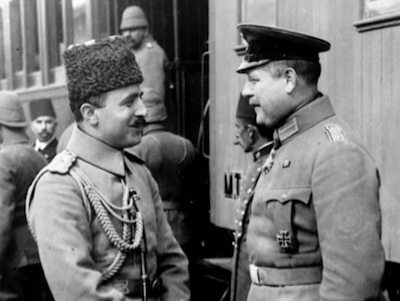
Enver Pasha with a German officer
Over time, differing viewpoints emerged within the Ottoman government regarding which group of powers the Empire should approach for an alliance. The majority among the government, the moderates, favoured an alliance with Britain and France, as they perceived these countries as posing the most significant threat to the Empire. In contrast, the extremists saw advantages in aligning with Germany and Austria-Hungary.
The moderates believed that Germany and Austria, due to their geographical positioning, did not pose a direct threat, and aligning with the Entente would reduce the peril faced by the Ottoman Empire. The initial diplomatic outreach was directed towards Britain as early as October 1911, when the Minister of Finance, Cavid Bey, informally conveyed the Sublime Porte's desire for an alliance with Britain in a letter to Churchill. Regrettably, the response was negative. A formal approach was made in 1913 by Ottoman Ambassador Tevfik Pasha, only to receive a polite but dismissive response.
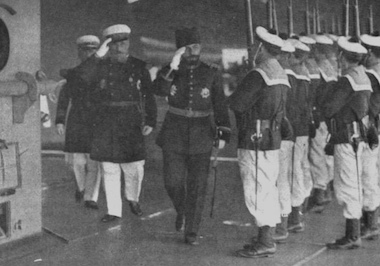
Cemal Pasha visiting the French naval base in Toulon
France was another nation contacted by the government. In July 1914, Cemal Pasha, the Minister of the Navy, was dispatched to Paris to negotiate an alliance. This endeavor also met with disappointment, as the French required Russia's approval and were unwilling to jeopardize their relationship with Russia. Cemal Pasha expressed profound disappointment in his memoirs.
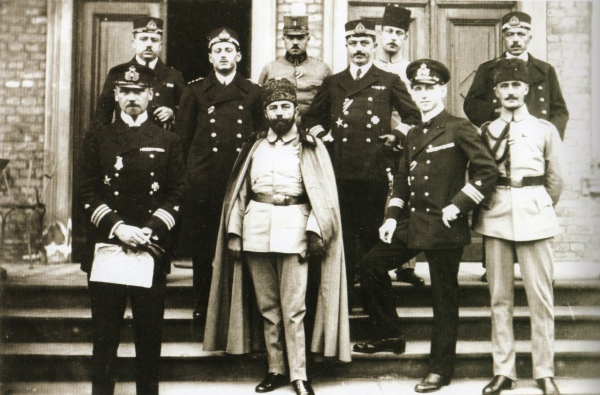
Cemal Pasha during a visit to Germany
Having been rejected by the Entente, the Sublime Porte had no alternative but to turn to the Central Powers. Extremists, including Enver Pasha, favoured aligning with Germany, which had the most formidable army in Europe and no territorial ambitions within the Empire. Cemal Pasha reflected:
"Germany can safeguard its interests only by ensuring the strength of Turkey. Germany is not in a position to subdue Turkey as a colony... To avert this outcome, Germany must guarantee the preservation of Turkey's territorial integrity." – Cemal Pasha, in his memoirs
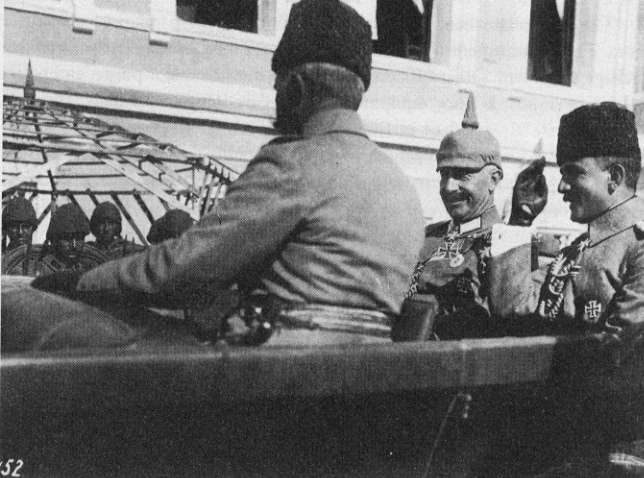
Enver Pasha and Kaiser Wilhelm
The alliance treaty was signed under strict confidentiality, and opinions within the Ottoman government were divided. For Talat and Enver Pasha, the treaty was a calculated risk; for Cavid Bey, it risked subordinating the Empire to German interests. The subsequent German naval action in the Black Sea in October 1914 settled the debate regarding Ottoman participation in the war.
