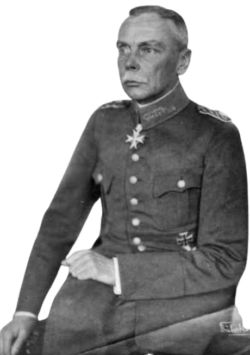
 Hans von Seeckt (1866–1936) was one of the most influential German military figures of the early twentieth century, shaping both wartime operations and the postwar evolution of the German army.
Born into a Prussian military family, Seeckt entered the army in the 1880s and rose through the ranks of the General Staff, gaining a reputation as a highly capable and analytical officer. By the outbreak of the First World War, he was already part of Germany’s elite planning circles. His real prominence came on the Eastern Front, where he served as chief of staff to August von Mackensen. In this role, he played a central part in planning major offensives, including the Gorlice–Tarnów breakthrough of 1915, which dealt a severe blow to Russian forces. His operational thinking, emphasizing concentrated force and rapid exploitation, contributed significantly to these successes.
In 1917, Seeckt was sent to the Ottoman Empire, Germany’s ally, as Chief of Staff to the Ottoman high command. His assignment reflected Berlin’s desire to strengthen coordination within the Central Powers. However, his influence there was limited by political realities. Ottoman decision-making remained firmly in the hands of leaders such as Enver Pasha, who did not always follow German advice. Seeckt worked to improve military organization and communication, while also acting as a liaison between German and Ottoman authorities. His tenure revealed both the challenges of coalition warfare and the constraints faced by even highly capable staff officers when operating within another state’s command structure. He remained in this role until the final phase of the war, helping manage the withdrawal of German personnel after the Ottoman collapse in 1918.
After returning to Germany, Seeckt became the central figure in rebuilding the German army under the restrictions of the Treaty of Versailles. As head of the Reichswehr (1920–1926), he transformed a limited force of 100,000 men into a highly professional and disciplined military institution. He emphasized rigorous training, flexible command structures, and the development of modern operational doctrine. Many of the concepts he promoted, particularly mobility, combined arms coordination, and initiative at lower levels of command, later influenced the military practices of the Wehrmacht.
Politically conservative and skeptical of the Weimar Republic, Seeckt sought to keep the army insulated from democratic politics, effectively turning it into a “state within a state.” Although he avoided direct political power, his stance during crises such as the Kapp Putsch revealed his ambivalent commitment to the republican system.
In later years, Seeckt briefly served in the German parliament and then worked abroad as a military adviser to Chiang Kai-shek in China, where he contributed to efforts to modernize the Chinese army. He died in Berlin in 1936.
Overall, Seeckt’s career combined battlefield planning, institutional reform, and international advisory roles. His time in the Ottoman Empire, though not his most influential period, provides an important window into the difficulties of alliance warfare and the limits of military expertise when confronted with political realities.
