In the years leading up to the First World War, the Ottoman Empire stood at the edge of collapse. A decade of nearly continuous conflict had stripped it of territory, drained its finances, and left its institutions in disarray. The Italo-Turkish War of 1911–1912 had cost the empire its last North African possessions, and the two Balkan Wars of 1912–1913 had been even more catastrophic, reducing Ottoman holdings in Europe to a narrow strip around Istanbul and Eastern Thrace. In less than three years, the empire had lost roughly 83 percent of its remaining European territory and approximately five million subjects. Hundreds of thousands of soldiers had been killed or taken prisoner, the treasury was effectively bankrupt, and a flood of Muslim refugees from the lost Balkan provinces was overwhelming an already fragile economy. The army was underequipped, its officers demoralized, and its supply chains shattered. The empire faced deep structural problems as well, including an inefficient bureaucracy, underdeveloped railways and infrastructure, and an agricultural economy that could not sustain industrial modernization. What the empire needed above all else was peace, foreign investment, and time to reform. What it got instead was the approach of the most destructive war in human history.
The Imperative of Alliance
- CUP leaders saw alliance as essential for survival due to Ottoman geopolitical vulnerability.
- Neutrality was deemed impossible given great power interests in Ottoman strategic regions.
- Efforts to secure alliances largely failed, with Russia’s interest implying dominance over Ottoman lands.
For the leaders of the Committee of Union and Progress (CUP), who had come to power after the 1908 revolution and consolidated control through the 1913 coup, the empire’s predicament was existential. Without foreign support, they believed, the Ottoman state would be unable to preserve its independence. The empire’s geostrategic location ensured that it could not be ignored, as it straddled Europe and Asia, controlled the Straits, and bordered Russia, the British Empire in Egypt and the Persian Gulf, and French influence in North Africa. Yet geography, while a source of importance, was also a source of peril. All of the great powers coveted Ottoman lands, and few had an interest in preserving the empire intact.
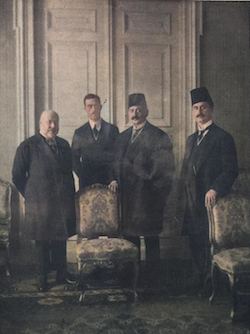
It was in this context that the Ottomans embarked on a desperate search for allies. Neutrality might have been the ideal option, offering the empire the respite it needed for recovery. By staying out of the impending European conflict, the empire might have secured time to rebuild its army, reform its administration, and revive its economy. But neutrality was never realistic as the empire lacked the resources to deter its rivals and the diplomatic capital to remain untouched in a world moving inexorably toward war. The Straits connecting the Black Sea and the Mediterranean were vital to Russian trade and security. Britain viewed the Ottoman position in the Persian Gulf and Mesopotamia as directly affecting its route to India. France regarded Syria and Lebanon as within its cultural and commercial sphere of influence. The Ottoman Empire’s very location ensured that both the Entente and the Central Powers saw its alignment as crucial. To attempt neutrality without the backing of a major power would have been to invite partition. The leaders of the Committee of Union and Progress recognized that an alliance with a major power bloc was unavoidable. The central question was not whether to ally, but with whom.
"Turkey had to align itself with one of the blocs in order to undertake vital domestic reforms, invigorate its trade and industry, expand its railway networks, and essentially, to endure and safeguard its existence." (Talat Pasha in his memoirs)
The challenge lay in the fact that the European powers were not particularly enthusiastic about forming an alliance with the ailing Ottoman Empire. At the outset of the Turco-Italian War in North Africa, Grand Vizier Sait Halim Pasha had conveyed the government's interest in establishing an alliance, and Turkish diplomats were tasked with gauging the interest of European capitals. It appeared that only Russia displayed some interest, albeit under terms that essentially implied a Russian protectorate over Ottoman territories.
The Failure of Entente Overtures
- Ottoman leaders split between Entente-leaning moderates and Germany–Austria supporters.
- Diplomatic efforts with Britain, France, and Russia all failed due to conflicting strategic interests.
- Great Powers valued Ottoman territory but not the survival of the Empire itself.
Over time, differing viewpoints emerged within the Ottoman government regarding which group of powers the Empire should approach for an alliance. The majority among the government, the moderates, favoured an alliance with Britain and France, as they perceived these countries as posing the most significant threat to the Empire. In contrast, the extremists saw advantages in aligning with Germany and Austria-Hungary.
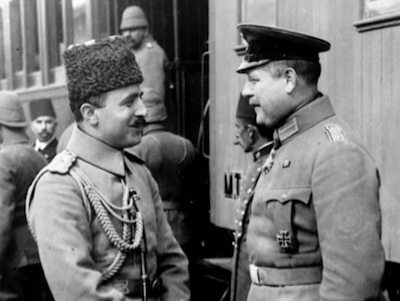
The moderates held the belief that Germany and Austria, due to their geographical positioning, did not pose a direct threat, and aligning with the Entente would reduce the peril faced by the Ottoman Empire. Beginning in 1911, informal approaches were made. Cavid Bey wrote to Winston Churchill, then First Lord of the Admiralty, signaling Ottoman interest in cooperation. In 1913, the Ottoman ambassador in London, Tevfik Pasha, formally requested an alliance. These overtures were not without substance. The Ottomans offered Britain access to railway projects in Mesopotamia, navigation rights on the Tigris and Euphrates, and a sphere of influence in Kuwait. Yet Britain declined. To London, the Ottomans were an unreliable partner and a declining power. More importantly, Britain’s alliance with Russia was central to its European strategy, and Russian hostility toward the Ottomans made an Anglo-Ottoman understanding impossible.
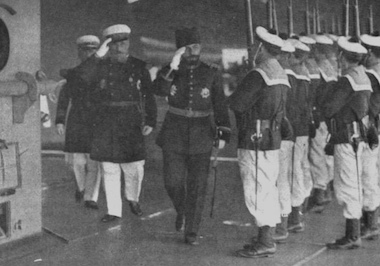
France was the next avenue. Cemal Pasha, Minister of the Navy and chairman of the Turco-French Friendship Association, travelled to Paris in July 1914 to explore possibilities. His personal ties to French officers and his command over naval cooperation projects gave him confidence. Instead, he was met with a blunt refusal. The French government insisted that no agreement could be made without Russian approval. Since Russia was determined to pursue its ambitions in the Straits, French alignment with St. Petersburg closed the door. Cemal left Paris bitterly disappointed, realizing that his pro-French orientation had no future.
Russia, paradoxically, was also approached. In May 1914, Talat Pasha travelled to Crimea to meet Foreign Minister Sergei Sazonov. He attempted to persuade the Russians that preserving the Ottoman Empire could serve their interests. But Russia, long focused on securing Constantinople and the Straits, had little incentive to guarantee Ottoman survival. Sazonov was polite but firm, Russia’s priorities lay in its alliance with France and Britain, not in rescuing a faltering empire.
These failures underscored a painful truth. The Entente powers valued Ottoman territory but not Ottoman sovereignty. Their interest was not in preserving the empire as a strong, independent partner, but in keeping it weak until the time came for partition.
Internal Divisions and the Turn Toward Germany
- Ottoman leaders were divided between maintaining neutrality and committing to Germany as the safer partner.
- German officials were initially skeptical, viewing the Ottoman Empire as militarily and financially weak.
- Kaiser Wilhelm overruled opposition and approved an alliance to open new fronts against the Entente.
The rejection by the Entente powers sharpened internal divisions within the Ottoman leadership. Moderates such as Cavid Bey favored continued neutrality, believing that aligning with Germany would tie the empire’s fate to a single power and expose it to ruin if Germany lost. They preferred to keep diplomatic channels open and to avoid binding commitments.
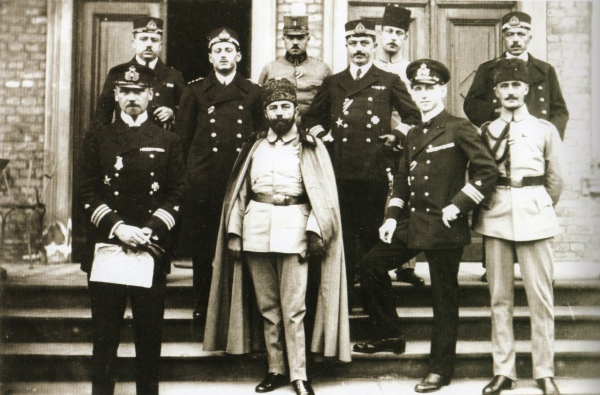
The government's extremists, including Enver Pasha himself, were in favour of aligning with Germany, as they believed that Germany possessed the most formidable army in Europe. They held the belief that Germany had no territorial ambitions within the Ottoman Empire, and thus, in comparison to the Entente powers, would pose a lesser threat to the Ottoman Empire if they emerged victorious in the war. They saw an alliance with Germany as a means to potentially safeguard the Empire from disintegration and even enhance its standing in the event of a German victory. Cemal Pasha, who had previously leaned towards an alliance with the Entente, reflected in his memoirs:
"Germany can safeguard its interests only by ensuring the strength of Turkey. Germany is not in a position to subdue Turkey as a colony, as both its geographical limitations and available resources render such an endeavor unfeasible. Hence, Germany is opposed to the partition of Turkey by the Entente powers, as Turkey provides a market that could be connected to its own. The disappearance of Turkey would leave Germany encircled within the steel ring of the Entente. To avert this outcome, Germany must guarantee the preservation of Turkey's territorial integrity." (Cemal Pasha in his memoirs)
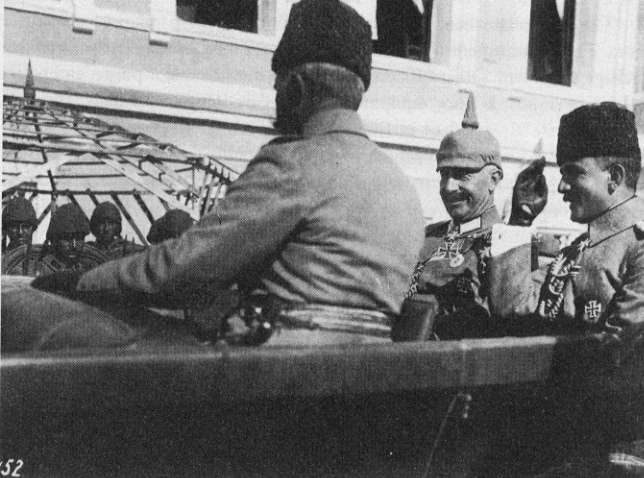
By that time, Germany had already established a substantial presence within the Empire. In 1913, a German military mission was assigned the task of restructuring the Ottoman army, and Germany had become deeply engaged in the Ottoman economy. Additionally, the German military leadership recognized the significant strategic value of the Ottoman army's active involvement in the impending conflict. However, the German government displayed reluctance in formalizing a military alliance with the Ottoman Empire. Many officials in Berlin regarded the Ottoman Empire as a liability. Its army was weak, its finances bankrupt, and its politics unstable. General Helmuth von Moltke dismissed it as “a dying man,” unlikely to contribute meaningfully to Germany’s war effort. This is why when, on 22 July 1914, Enver Pasha proposed an alliance to the German Ambassador, Hans von Wangenheim, the proposal was rejected.
Kaiser Wilhelm, however, had a different view. Recognizing an opportunity in having the Ottoman Empire as part of the Central Powers, overruled the ambassador's decision. Despite the Ottoman army's relative weakness, it still had the potential to create substantial concern for the Entente by launching attacks on British holdings in the Middle East and Russian territories in the Caucasus. The Kaiser's aim was to open additional fronts against the enemy and exploit all available means at their disposal. He instructed Wangenheim to sign the alliance treaty under the condition that the Ottoman Empire would swiftly take action against Russia, which it eventually did.
The Secret Treaty, the Parallel Gambit, and the Road to War
- The secret Turco-German Alliance reflected deep divisions in Istanbul between moderates who feared dependence on Germany and pro-German leaders who saw alliance as survival.
- Ottoman leaders briefly explored neutrality and even alternative alignments, but Europe’s powers rejected Ottoman overtures, leaving the Empire increasingly isolated.
- Germany was reluctant but accepted the alliance for strategic gain; the Ottoman Empire was drawn into war after the Goeben–Breslau incident, making neutrality impossible and locking it into a high-risk partnership.
The Turco-German Alliance was signed on 2 August 1914, the day after Germany declared war on Russia and two days before Britain entered the conflict. It was concluded under strict confidentiality, with only five individuals in Turkey privy to its existence. Cavid Bey criticized it, contending that it would subordinate the Empire to German interests. On the contrary, Cemal Pasha, who learned about the treaty a day after its signing, welcomed the Empire's alignment with one of the two major power blocs. Sait Halim Pasha held a more naive perspective, hoping the treaty would enable the Empire to maintain its neutrality in the war, although this expectation was evidently unfounded. In contrast, Talat Pasha and Enver Pasha understood that the document would draw the Ottoman Empire into the war. For Talat, it was a calculated risk, recognizing that they had little chance of staying out of the impending conflict. However, a potential German victory held the promise of rescuing the Empire from the dire straits it was in. For Enver, siding with the Germans also aligned with his aspirations for pan-Turkic objectives in Asia.
At that juncture, the moderates in the government displayed little enthusiasm for taking sides in the war; their primary goal was to exploit the international situation to secure full independence and concentrate on domestic reforms. They aimed to reassure the Entente that the Ottoman Empire would maintain its neutrality. In contrast, the extremists were inclined towards participating in the conflict.
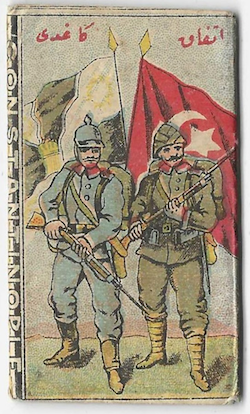
Just a few days after the Turco-German treaty was officially sealed, Enver made a surprising overture to the Russian military attaché in Istanbul, General Leontieff. He proposed a potential Turco-Russian alliance in exchange for the recognition of the Ottoman Empire's independence and a favorable reconfiguration of the Balkan map in its favour. The Russian side did not outright reject the offer, but they refrained from entering into any formal commitment. It remains uncertain whether Enver intended to buy time or genuinely contemplated aligning with Russia and joining the war against the Central Powers.
As the hostilities on the European continent were already underway, there was a contentious debate within the Ottoman government between the moderates and the extremists regarding whether the Ottoman Empire should enter the war or maintain a position of neutrality. In late October 1914, the decision was significantly influenced by a fait accompli: a German admiral, commanding two ships, Goeben and Breslau, sailed them to the Black Sea under the Turkish banner and initiated a bombardment of Russian ports. The bombardment forced Russia to declare war, followed by Britain and France. With that, the Ottoman Empire was irrevocably drawn into the conflict.
The Ottoman Empire’s search for allies was not a carefully calculated strategy but a desperate gamble born of weakness. The Entente powers dismissed its overtures, preferring to preserve their own alliances and prepare for partition. Internal divisions sharpened, but ultimately the radicals led by Enver prevailed, persuaded that Germany was the “least dangerous” choice.
For Germany, the alliance was initially undesirable but ultimately accepted for strategic reasons. For the Ottomans, it was both a lifeline and a trap. The alliance prolonged the empire’s existence in the short term, tying it to a powerful protector. Yet it also ensured that defeat in the global war would bring catastrophe. The Ottoman Empire was too weak to stand alone, too mistrusted to attract partners, and too entangled in global rivalries to remain neutral. The decision to side with Germany was the only option left, but it came at the highest possible cost.

PAGE LAST UPDATED ON 29 AUGUST 2025